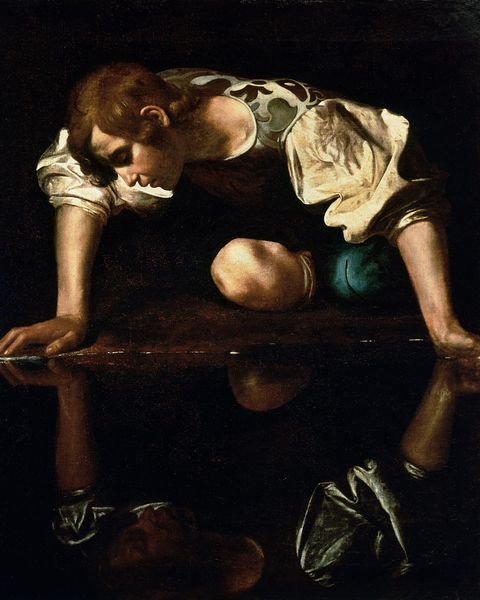
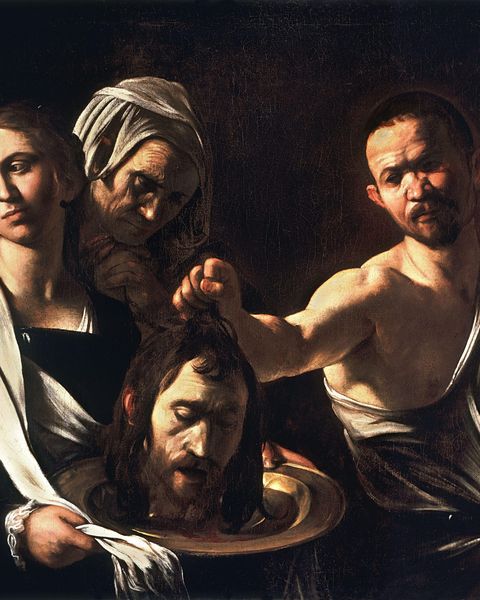
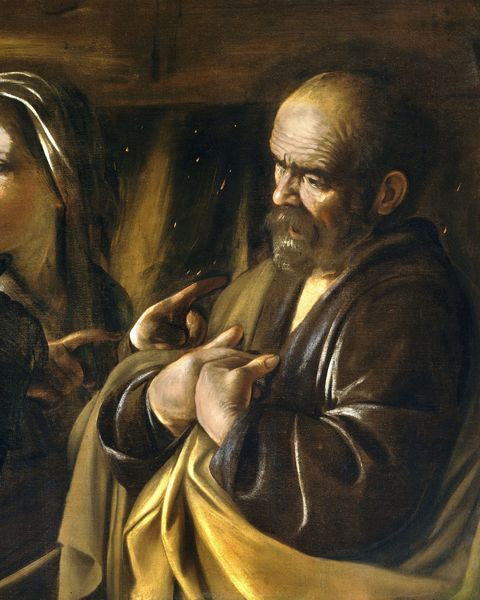
Four sessions on the life and paintings of Michelangelo Merisi, 1571–1610
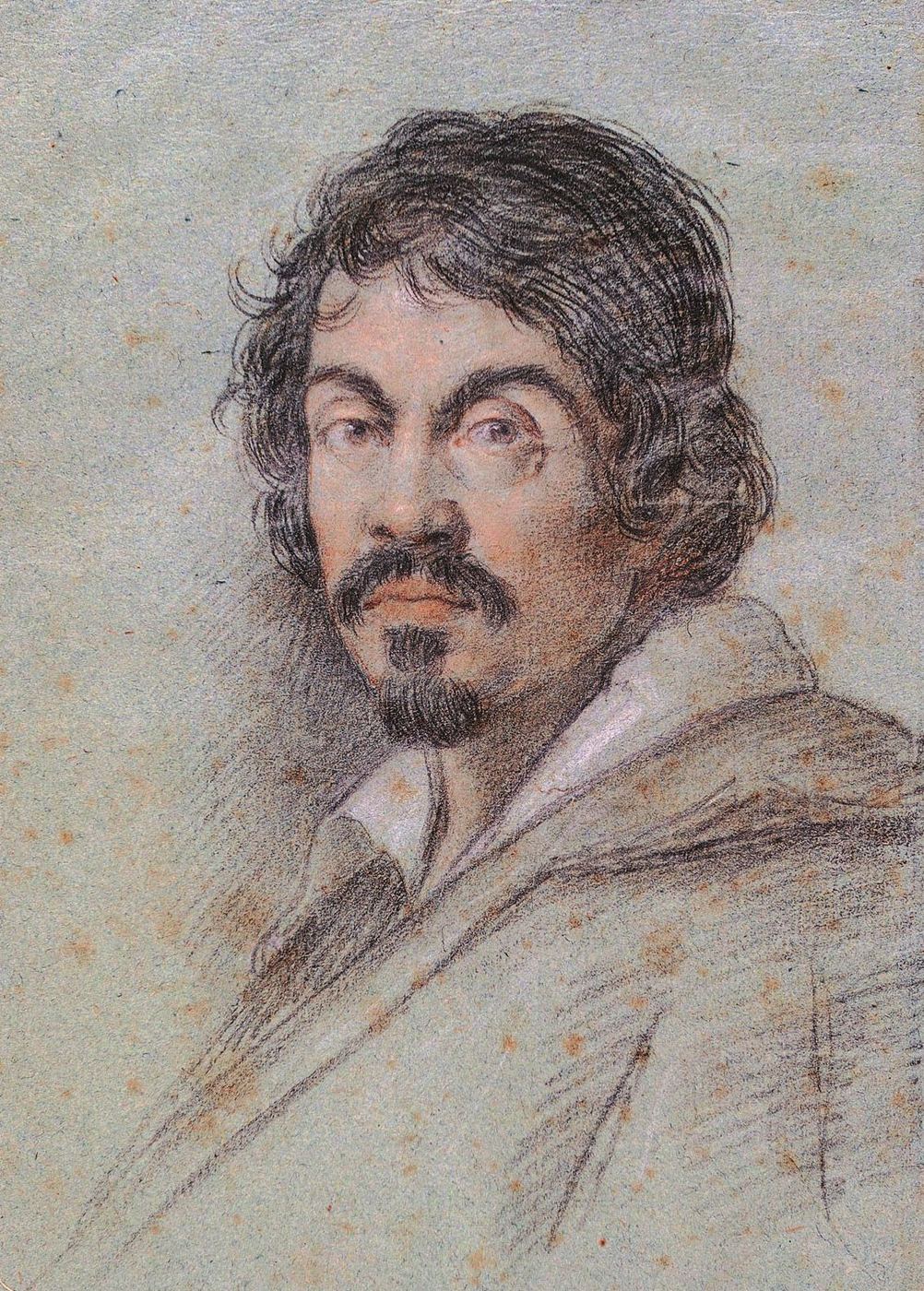
Ottavio Leoni, portrait of Caravaggio, c. 1621
Before we begin
Like Spinoza in philosophy, Marlowe in theatre, and Borromini in architecture, Michelangelo Merisi da Caravaggio possessed an intelligence, a unique insight, and a passion for his own view of the truth that changed painting forever. The skill he demonstrated, the subtlety he brought to drama, and the pathos he could evoke in a viewer are extraordinary. He was certainly a troubled genius, but a genius nonetheless. His life was chaotic and violent, yet, like a Tarantino character — a hit man quoting Ezekiel before he pulls the trigger — he paired that violence with wit, erudition, and an unusual ability to read the moment in which he lived.
I have no formal education or training in art history or criticism, and I am certainly not an artist myself. I am simply an exuberant fan.
Apart from a few paintings that have been lost or destroyed, every Caravaggio discussed here is one I have stood before, at least once, and considered seriously. After years of self-study, I have tried to present the information and judgments that most experts on this master share. I also offer my own impressions, reactions, and assumptions. And you may disagree.
That, for me, is one of the special things about art. It allows each of us to see different things in what we view, and to feel different emotions about what we see, and each of us may be equally correct. You will decide for yourself which, if any, of Caravaggio’s works you enjoy and which you dislike. I am only confident that, after seeing and thinking about his art, you will not be indifferent to it.
Using this site
The first three sessions follow the painter’s life and work in order. Session I covers his early years in Milan and the nearby town of Caravaggio, his arrival in Rome, and his first paintings. Session II follows his rise to become Rome’s most celebrated painter, while his life grew ever more chaotic and violent. Session III tracks him as a fugitive after he killed a man in 1606, through Naples, Malta, and Sicily, and the paintings he made as he sought a pardon. Session IV gathers paintings I have seen that are not discussed earlier, and ends with recommended reading and a list of references — the sources behind much of what you will read here.
New to Caravaggio? Start with the Session I introduction and use the Next button at the bottom of each page to read straight through.
The Session menus at the top of every page open with an Introduction, followed by that session’s chapters. Each introduction lists that session’s chapters and, below the text, shows small pictures of its paintings; click one to see it larger.
On a chapter page, the list on the left shows where you are. In longer chapters it names each painting, so you can jump straight to one or find your place again. On a phone, use In this chapter under the chapter title.
Click any picture to see it on a dark screen. Click it again to zoom in, and drag to look around. Underlined painting titles in the text open that painting too.
Artworks lists every Caravaggio painting discussed, A to Z or by year, with links to where each one appears.
Gallery lets you play curator: an empty room where you hang three or four paintings of your choice side by side.
Caravaggio’s paintings in these sessions
Artworks
Order
38 paintings. Dates are as given in the class notes; “c.” means about.
Also known as Salome with the Head of John the BaptistNational Gallery, LondonDiscussed in Session III
c. 1609–10
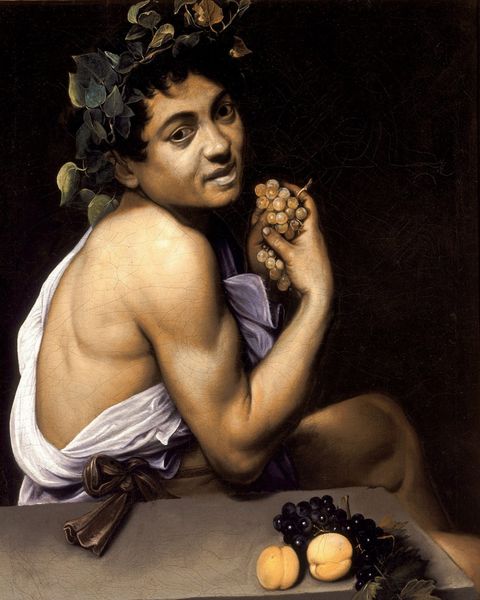
Also known as Sick Bacchus or Bacchino malatoGalleria Borghese, RomeDiscussed in Session I
c. 1593–94
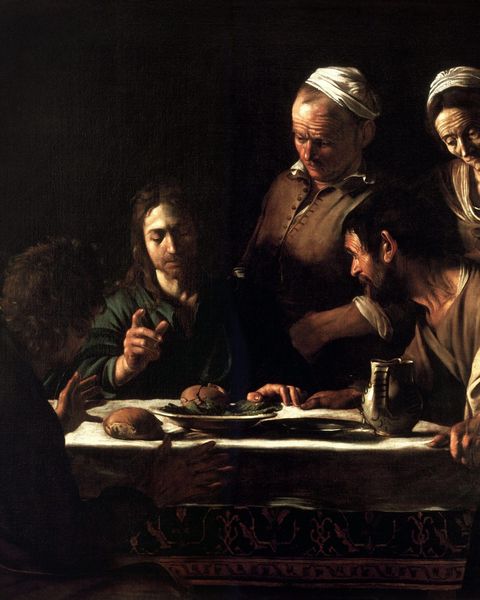
Also known as the London Supper at EmmausThe National Gallery, LondonDiscussed in Session ISession II
1601
Also known as the Brera Supper at EmmausPinacoteca di Brera, MilanDiscussed in Session III
1606
Be the curator
Your Gallery
Every museum curator decides what hangs beside what. Here is an empty room. Choose three or four of the paintings from these sessions, hang them side by side, and see what they say to each other.
Click a painting below to hang it in the next empty space, or click an empty space first to choose where it goes. Click a hung painting to look at it closely; × takes it down. Everything hangs to true scale, so the giants of the chapels tower over the early studio pictures.
He was born in Milan on September 29, 1571. We would like to believe his parents had the gift of foresight and named him in homage to Michelangelo Buonarroti, the Florentine — but in fact he was born on the feast day of the Archangel Michael. And so, Michelangelo Merisi.
We call him “Caravaggio” because that is the name of the family’s nearby ancestral town. And so, Michelangelo Merisi da Caravaggio.
Two Influences — Trent and Borromeo
The Council of Trent (1545–1563) was the Roman Catholic Church’s response to Martin Luther’s Reformation. Reformers such as Calvin vigorously rejected religious art. The Council took the opposite approach: instead of banning art, the Church decided to weaponize it.
Art had to be easily understood by the average, illiterate churchgoer. A painting of a biblical scene was meant to look like the biblical scene — acting as a visual sermon. By demanding art that was immediate, dramatically clear, and intensely moving, the Counter-Reformation directly paved the way for the Baroque era.
Cardinal Carlo Borromeo (1538–1584), Archbishop of Milan and later Saint Charles Borromeo, shaped the culture of Caravaggio’s youth. He was the Council of Trent’s most zealous enforcer. The only goal of art was to move the common people closer to the Catholic faith, so painting should be faithful to the truth as a devout Catholic would understand it: if a saint embraced poverty, he or she should be shown in humble dress.
In his Instructions on Church Building (1577), Borromeo told bishops to ensure that nothing was painted or sculpted that contradicted the truth of scripture, tradition, and church history. It was the concept of TRUTH that would most affect our painter.
“And if any abuses have crept in amongst these holy and salutary observances, the holy Synod ardently desires that they be utterly abolished; in such wise that no images, (suggestive) of false doctrine, and furnishing occasion of dangerous error to the uneducated, be set up.”
Council of Trent, Session XXV, December 1563 (Waterworth translation)
While the Council of Trent and Cardinal Borromeo influenced Caravaggio’s culture, a plague would change his life. The devastating bubonic plague that struck Milan and Lombardy from 1576 to 1577 is named after the Cardinal himself — the Plague of San Carlo — for his selfless care of its victims. Should I ever be canonized, I would prefer a school rather than a plague to bear my name — but that’s just me.
Plague is relentless — as the world would be reminded nearly 450 years later. Between 15% and 20% of the area’s population would die, most in horrible ways. Michelangelo Merisi’s family left Milan, a city of about 130,000, for their ancestral village of Caravaggio, home to about 3,000. It reached them anyway. At six, Michelangelo lost his father and his grandfather to the disease on the same day.
Caravaggio is frequently the subject of armchair psychoanalysis, but surely a boy of any century would be marked for life by the sudden death of the two most important men in his life.
If Caravaggio was to turn art away from the Renaissance and usher in the Baroque, it helps to understand what characterized each of them.
The Renaissance period of art ran from roughly 1300 to 1600. In the Proto-Renaissance (1300–1400), Giotto gave his characters some physical weight; before him, art tended to be flat and two-dimensional. The Early Renaissance (1400–1500), firmly based in Florence, saw the development of perspective: Brunelleschi in architecture, Donatello in sculpture, Masaccio or Botticelli in painting.
In the High Renaissance (1500–1525), papal Rome and Venice became the great centers. This was the age of technique, symmetry, harmony, and ideal beauty — of Leonardo da Vinci, Michelangelo, and Raphael. Then came Mannerism (1525–1600): elongated figures and distorted proportions, unnatural color and light — bright pinks and metallic blues. Think of Parmigianino, Bronzino, and El Greco.
The Baroque
1600–1750 · what replaced it
The hallmarks of the Baroque are chiaroscuro and tenebrism, dynamic composition — composition that tells a story in itself — and uncompromising realism. Its great names include Caravaggio and Diego Velázquez in painting, Gian Lorenzo Bernini in sculpture, and Francesco Borromini in architecture.
Chiaroscuro is the ordinary business of painting with light and shade so that a flat surface holds volume and depth; painters had been doing it for a century before Caravaggio was born. Tenebrism, from tenebroso — dark, murky — describes a picture in which the darkness takes the lead and a single hard light picks out a face, a hand, the edge of a blade, and lets the rest fall away.
All tenebrism is chiaroscuro; very little chiaroscuro is tenebrism.
When you visit Rome today, you see the heavy influence of the Baroque everywhere. Bernini’s Fontana dei Quattro Fiumi (Fountain of the Four Rivers) of 1651 is the centerpiece of Piazza Navona, and along the piazza’s edge stands the church of Sant’Agnese in Agone, whose façade Borromini began remaking in 1653. Even Saint Peter’s Square is a Baroque design.
Renaissance vs Baroque — at a Glance
What changed when Caravaggio arrived, around 1600
Set side by side, the two periods part ways on almost everything: the light, the mood, the people, the composition — and where they put you, the viewer.
The Shape Beneath the Picture
Raphael × Caravaggio
Two ways of holding a painting together. Raphael’s The Madonna of the Goldfinch (1505–06) is built on a triangle. Caravaggio’s (1600–1601) is built on an inverted triangle.
Two Paintings, One Museum — Kansas City
Bronzino × Caravaggio
Bronzino’s Portrait of a Young Man (c. 1550–55) and Caravaggio’s (c. 1604) hang in the same museum, the Nelson-Atkins in Kansas City. Bronzino’s Mannerist approach lengthens the face and hands, creating an almost vampiric image. Caravaggio presents the truth of both young male form and emotion — cool, polished artifice beside warm, breathing flesh.
The Conversion of Saint Paul
Raphael × Caravaggio
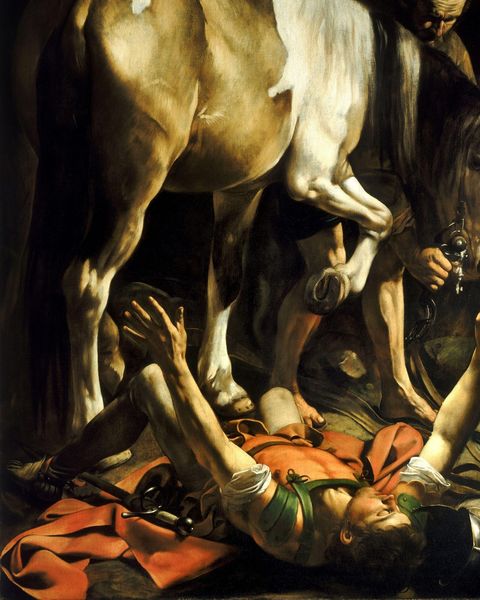
Raphael creates spectacle: Saul — later Paul — is almost lost amongst trampling soldiers, and Christ comes popping out of the sky. Caravaggio centers the story on the man affected by conversion.
A Supper with Christ
Leonardo × Caravaggio
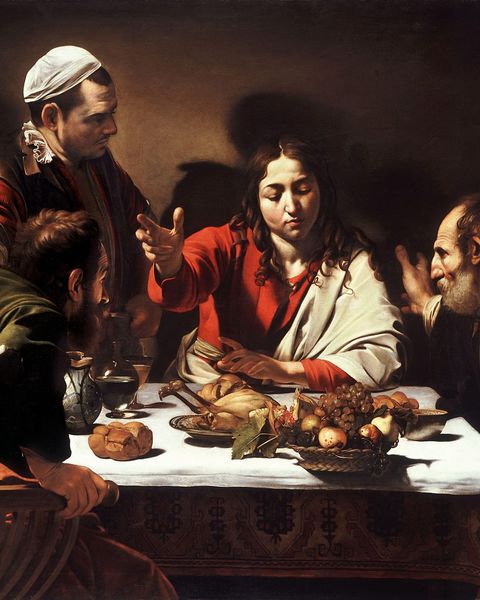
If one didn’t know the story, could one see the miracle in Leonardo’s version? Caravaggio leaves no doubt something exceptional is taking place. You can imagine yourself seated at the table.
Apprenticeship was the normal path for anyone wanting to become a painter in Europe. Painting was long classified as a manual craft rather than a liberal art, and the local trade guilds in most cities required an apprenticeship before an artist could practise independently.
At 12, Michelangelo took a four-year apprenticeship with Simone Peterzano, a mediocre Lombard painter. His mother signed the documents, paying Peterzano 24 gold scudi for the privilege. Peterzano would teach him the basics of his craft and, in return, use him as a minor assistant and all-around indentured servant — menial household tasks, grinding and mixing paint, building brushes.
France and Spain had long fought over Milan, and by the time of Caravaggio’s apprenticeship the city had been under Spanish rule for half a century. Its art, though, looked east to Venice. Peterzano signed himself “Titiani alumnus” — a student of Titian, the great High Renaissance Venetian painter. If Caravaggio was naturally rebellious, the soft, colorful, and idealized painting of his master was an obvious target.
A steward’s son, bound to the mighty Sforza and Colonna
Michelangelo Merisi’s family was bound to the house of Sforza on both sides. His father, Fermo, was steward and architect (maestro di casa et architetto) to Francesco Sforza, Marchese of Caravaggio, and his mother’s father, Giovan Giacomo Aratori, was the Marchese’s legal agent and rent collector.
Francesco’s wife, Costanza Colonna, came from one of the oldest and most powerful families in Italy, with influence reaching even to the Knights of Malta. Her father, Marcantonio Colonna, commanded the papal fleet at Lepanto in October 1571 — the month after Michelangelo was born.
Francesco stood witness at Michelangelo’s parents’ marriage in January 1571. The bond was closer than patronage: his mother Lucia’s sister, Margherita, was wet nurse to Costanza’s children — Michelangelo’s aunt suckled the Marchesa’s babies.
Francesco died in 1583, when Michelangelo Merisi was eleven, and Costanza ran the estate at Caravaggio herself. She would become a sort of guardian angel to the wild painter — and she would still be sheltering him at the very end of his life, a story for the third session.
In 1590 came another blow: his mother died, making him fully an orphan. He had a small inheritance from the sale of property. Historians believe that when he wasn’t painting for Peterzano, Caravaggio was roving with a small gang of street thugs and getting into fights.
The Gate He Would Have Walked Through
Porta del Popolo · Rome, c. 1592
Sometime in the early 1590s — traditionally in 1592 — Michelangelo Merisi would have entered Rome through the city’s north gate, the Porta del Popolo — the main entrance for visitors and pilgrims from the north since the 270s CE. Galileo, Martin Luther, and Michelangelo Buonarroti would all likely have walked through it. In fact, Buonarroti advised on the façade, built to his counsel in the 1560s, so the gate was barely thirty years old when the painter arrived.
That date is less certain than it once seemed. In 2011 a researcher in Rome’s State Archives turned up a sworn statement by a barber’s assistant suggesting Caravaggio may not have arrived until about 1596, which would leave four years of his life unaccounted for. Most biographies, and this site, still follow the traditional dates, but the early Roman years should be read with a little caution.
He came to Rome dirt poor and struggled to make a name for himself. Rome was swelling with new arrivals — laborers, discharged mercenaries, and pilgrims — who crowded into the dense warren of streets along the Tiber. Giovan Pietro Bellori claimed the painter arrived nudo e bisognoso — literally, “naked and needy.”
Historians have identified three relationships Caravaggio developed during these early years in Rome: with Monsignor Pandolfo Pucci, with Antiveduto Grammatica, and with Giuseppe Cesari, the Cavaliere d’Arpino.
First, he was taken in by Pucci, a well-connected churchman who employed him as a copyist of small, easily transported devotional pictures. The early biographer Giulio Mancini says these copies went home to Recanati, Pucci’s own town — the copying was his way of paying the rent.
Tradition places this first lodging in the Palazzo Colonna, and Costanza was in Rome that very year. No document proves she arranged it, and some credit his priest uncle Ludovico instead. But it is the same family he would run to in 1606, after killing a man.
Pucci’s excessive frugality — feeding his painter servants only vegetables — led Caravaggio to call him “Monsignor Insalata” (Monsignor Salad).
Antiveduto Grammatica
An undistinguished painters’ workshop
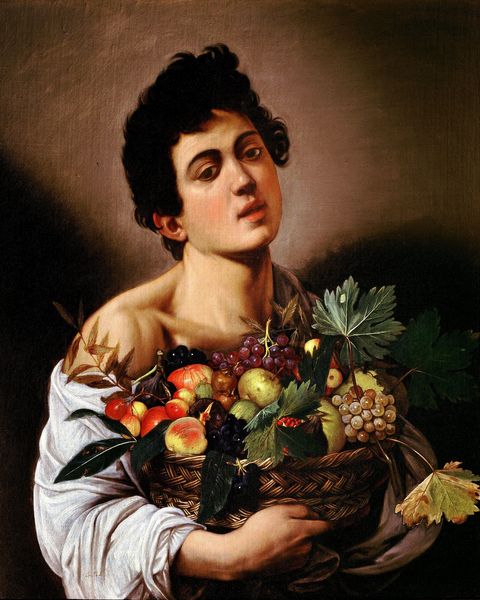
Next came brief employment with a relatively undistinguished painters’ shop run by Antiveduto Grammatica. It would be interesting to know when Grammatica painted the picture shown here, because we can see a suggestion of Caravaggio in it: the tenebrism that places most of the painting in shadow, and the attention to detail in the folding fabric and the woven basket of fruit. Did Grammatica influence Caravaggio — or was it painted later, after Caravaggio’s fame, and so influenced by him? Who influenced whom?
The Cavaliere d’Arpino
Giuseppe Cesari — the more prestigious artist
He then migrated to a more prestigious artist, Giuseppe Cesari, the leading master of Late Mannerism in Rome, better known as the Cavaliere d’Arpino — Pope Clement VIII would knight him around 1600. When Caravaggio was in his shop in 1593–94, Cesari was twenty-five, already principal painter to the Pope. He will reappear in this story a couple of times.
Caravaggio was given menial painting tasks — peripheral details like fruit, flowers, and foliage. There he developed a still-life skill that would accentuate his later masterworks, such as The Supper at Emmaus (National Gallery, London — 1601).
Still Life as Life
The fruit, the basket, the table
Follow that still-life skill through his work: the fruit on the ledge in the (c. 1593–94), the (c. 1595), the basket in the (c. 1596), and the table in The Supper at Emmaus (1601).
This is one of the earliest paintings we have from Caravaggio, and in it he is already demonstrating one of his defining traits — realism as opposed to idealism.
Around this time Caravaggio fell ill and was taken into the Ospedale della Consolazione. Why isn’t fully known. Some suggest, by virtue of the painting’s color, that he was suffering from malaria; others believe a horse had kicked him while he was working for Giuseppe Cesari.
Likely painted with a mirror, this is the portrait of the artist as a sick man. It shows two Caravaggios at once: the young man, ill and recovering, and the party-boy Bacchus, god of wine, mirth, and excess. He may even have painted to pay for his care.
Another way to read it is as a calling card: a still life, the grapes so faithful you nearly reach for one; a portrait, his own face caught in a mirror; and a figure from classical myth.
My own reactions? The boy’s face is a bit disturbing, his eyes not quite meeting yours. The shoulder jutting forward almost comes off the canvas into the viewer’s space. To me, his face looks older than his body. And what is he wearing — a scrap of draped linen? The fruit is magnificent: natural, dusted, overripe and at times bruised.
I fail to see within this face the angry swordsman, the street brawler he would become. The face says to me: despite illness or injury, I, Michelangelo Merisi, a young man who carries the name of a small Lombard village, can be someone special in Rome. It is a borrowed god’s crown of ivy, worn like a laurel of fame yet to come.
It stayed in the Cavaliere d’Arpino’s studio until 1607, when Cardinal Scipione Borghese confiscated it, which is why it hangs in the Galleria Borghese today.
“Meanwhile he was struck by an illness which, finding him without money, forced him off to the Hospital of the Consolazione, where during his convalescence he made many paintings for the prior.”
Giulio Mancini (1559–1630)
Genre Paintings
Reimagining the Genre Painting
Van Leyden × Caravaggio
It was with a category called “genre painting” that Caravaggio first transformed art.
Before Caravaggio, genre paintings — scenes that depict everyday life, ordinary people, and common activities — were predominantly a northern European trend. Grand history paintings (biblical, mythological, or historical allegories) sat securely at the top, while genre scenes and still lifes were relegated to the bottom. Pre-Caravaggio genre paintings could often be a dull affair.
Caravaggio upended common thinking by infusing the genre with gritty street-life detail and a tight emotional structure. His were suspenseful tales full of intensity.
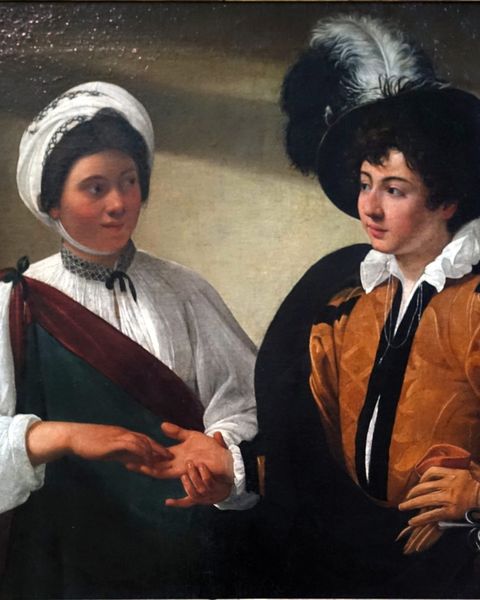
The Fortune Teller
Caravaggio · c. 1595 · Musée du Louvre, Paris
Unlike his copyist drudgery for Pucci or his limited work for Cesari, this painting was entirely his own. A series of genre paintings would become his access to future fame. How many he did, or how many versions of each, isn’t known; we have two of The Fortune Teller, one in the Capitoline Museums, Rome (c. 1594), and this one in the Louvre (c. 1595). Once a painting caught on, someone in a patron’s circle would want one of their own: social currency among Rome’s upper crust.
Likely using a real girl and boy from the neighborhood as models, the artist shows streetwise seduction and deception. So entranced is the boy by the young Romani girl that he doesn’t notice the ring being slipped from his finger. Historians believe the dupe is Mario Minniti, a Sicilian who would appear in other Caravaggio paintings and later become a successful painter himself. Following the same people through different roles across Caravaggio’s work is a favorite pastime of those captivated by him today.
In the art and literature of the day, the Romani were conventionally portrayed as dirty, amoral thieves. Caravaggio’s Romani woman is, yes, a thief — but a thief of a heart as well as a ring: a pretty girl, well-dressed and neat, as biographer Graham-Dixon says, “smiling poverty personified.”
Caravaggio is believed to have worked directly from models posed in his studio. Unlike most painters of his time, he left no drawings that we know of, and examination of his canvases shows no detailed underdrawing and no “cartoons,” the full-scale drawings used to transfer a design onto canvas. He simply painted: sometimes scoring a guide line into the wet ground with the end of his brush, sometimes painting over an unsatisfying attempt, but painting.
It was, in its way, revolutionary. As Graham-Dixon puts it, “…Caravaggio’s tricksters spawned a whole world of painted rogues…” — embraced by artists such as Georges de La Tour and Rembrandt.
“I don’t know who is the greater sorcerer / The woman you portray / Or you who paint her.”
Gaspare Murtola, madrigal, 1603
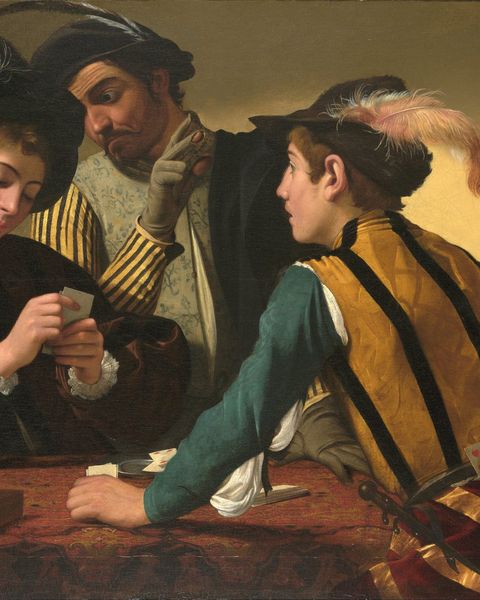
The Cardsharps
Caravaggio · c. 1595 · Kimbell Art Museum, Fort Worth
The painting is a step forward from . Caravaggio adds a third character and builds a triangle of expressions and tensions — a swindle caught at the instant it occurs.
The mark, on the viewer’s left — Mario Minniti again — is playing another dupe, this time entranced by the prospect of winning. With his white linen ruffled sleeves, fashionable doublet, rich velvet cap, clean and cared-for hands, and sweet demeanor, he is the perfect mark: old Roman money waiting to be taken.
Note the backgammon board sitting unsteadily on the table. Has the boy already lost money he needs to win back? With the depth it gives the table, we can almost imagine ourselves standing across from the grifter, part of the action.
The cheat, a young grifter barely older than the mark himself, leans in, reaching behind for a hidden card. We clearly see the handgrip of a dagger. If this goes south, violence isn’t out of the question.
Managing it all is the signaler, the old pro of the trio. His bare fingers, protruding from torn gloves, tell us he is a professional: bare fingertips better feel a marked card. His expression tells us this isn’t a game.
For me, the most magnificent detail in the painting is the feather in the younger cheat’s hat. Study it and it seems almost impossible to have been painted — dozens of airy strands, whose colors blend and separate, giving the plume the undulation of a Borromini church wall.
Cardinal del Monte
Francesco Maria Bourbon del Monte Santa Maria (1549–1626)
Cardinal Francesco Maria del Monte was a wealthy, sophisticated prelate who loved art. He represented the Medici of Florence in Rome, and his home, Palazzo Madama, was a Medici palace. Today it houses the Italian Senate.
He was made a cardinal by Pope Sixtus V in 1588 on the strong recommendation of Ferdinando de’ Medici, who had resigned his own cardinalate to succeed his late brother as Grand Duke of Tuscany.
A few steps from the palazzo was the stall of Costantino Spata, who sold the work of little-known painters, retail. There del Monte saw both and . He bought them both.
He invited Caravaggio to move into the palazzo and set up a small studio. This was the critical break Caravaggio needed — a wealthy, connected cardinal who would show off his paintings to other Roman powerbrokers and influencers.
Religious Paintings
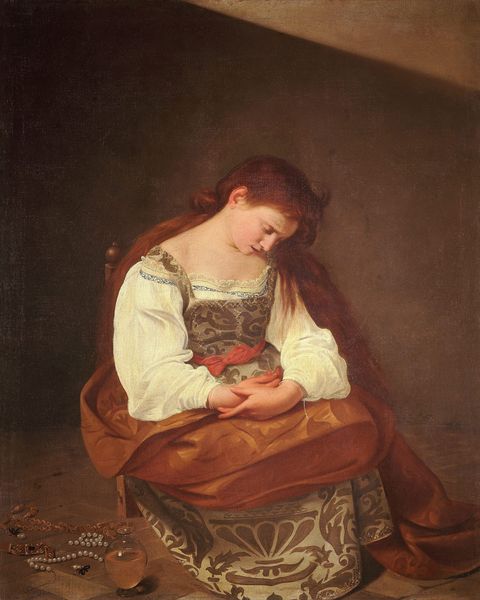
Penitent Magdalene
Caravaggio · c. 1594–95 · Galleria Doria Pamphilj, Rome
This painting, with the , has been in the Pamphilj collections at least since the mid-seventeenth century. The Palazzo Doria Pamphilj, on the busy Via del Corso, hides an opulent interior behind a nondescript gray exterior; surprisingly, it remains a private residence that opens its doors (for a fee) to the public.
This work was considered shockingly unorthodox by contemporaries — an extreme example of Caravaggio’s obsession with showing reality. How, a conservative theologian might ask, does it teach any good Christian to emulate the life of Saint Mary Magdalene? Where is the divine presence that motivates her new commitment to her God?
Maybe this was how he imagined the woman who, since Pope Gregory the Great in the sixth century, had been taken for a reformed prostitute. She is painted from above, seated low to the ground — “humility” derives from the Latin humus, meaning ground. She sets aside her worldly possessions, pearls and gold, and sits in contemplation. Graham-Dixon believes there is no other painting of this period like it.
Compare Francesco Panigarola, the great preacher of Borromeo’s Milan: “Casting down her necklaces and jewels, shaking her tresses, violently wringing her hands, she trembled…” In Caravaggio’s picture, a simple girl sits with her head bowed, alone, a single tear falling from her downcast eyes.
She could be any woman struggling with any of a number of indignities. In this young woman, trying to find a good choice among bad ones and not quite succeeding, Caravaggio may be quietly telling a story about the women of sixteenth-century Rome, one a woman visiting Rome today might recognize.
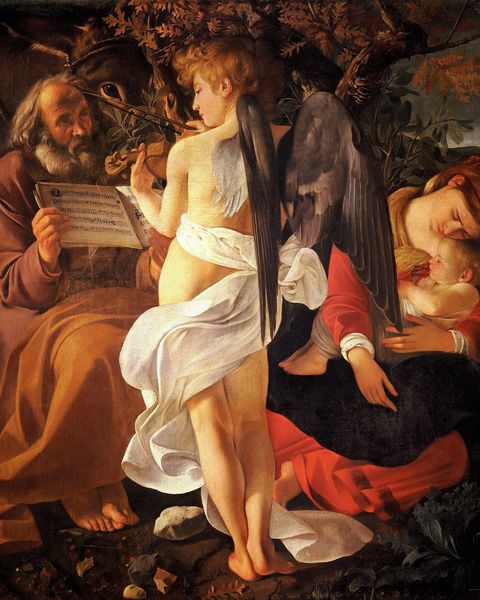
Rest on the Flight into Egypt
Caravaggio · c. 1597 · Galleria Doria Pamphilj, Rome
The early biographer Giulio Mancini says that Caravaggio, after leaving Cesari and the hospital, lived for a time with Monsignor Fantino Petrignani, who gave him “la comodità di una stanza” (the comfort of a room) — and that Petrignani commissioned this painting. The claim is hard to sustain. None of the paintings Mancini assigns to those months appears in Petrignani’s own inventory of 1600, and the angel’s pose derives from Annibale Carracci’s Choice of Hercules, not finished until early 1596. Several scholars assert it was instead a commission from Cardinal del Monte, or painted to catch his eye.
What we do know is where it ended up. Archival work published in 2009 established that this painting and the both belonged to Alessandro Vittrice, and that his sister Caterina sold them to Camillo Pamphilj on 30 October 1650 — which is how they come to hang together in the Doria Pamphilj today.
The painting itself far exceeds any online or printed image; it rewards close looking. Notice the many shades in the dark wings of the angel, and skin tones that run from the creamy pale of the angel to the sun-browned face of Joseph.
An exhausted mother cradles and protects her infant, the baby Jesus at peace. The father holds the score sheet for the angel’s music-making, genuine curiosity in his face. And here is a Caravaggio with a vista: far-off mountains in half light — one of his very few landscapes.
The music the angel plays has been identified as a motet by the Flemish composer Noël Bauldeweyn, with words from the Song of Songs — Quam pulchra es, “How beautiful you are.” It is a sophisticated touch not typically associated with a young artist.
Other Early Works
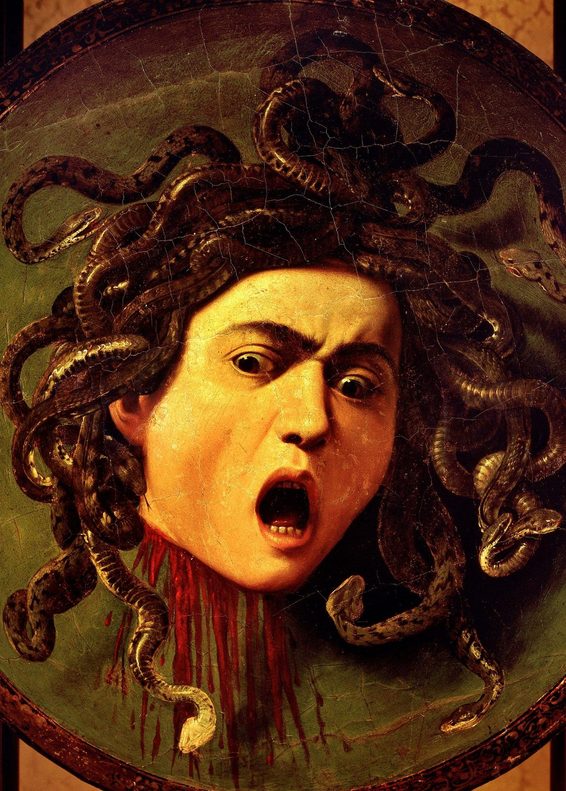
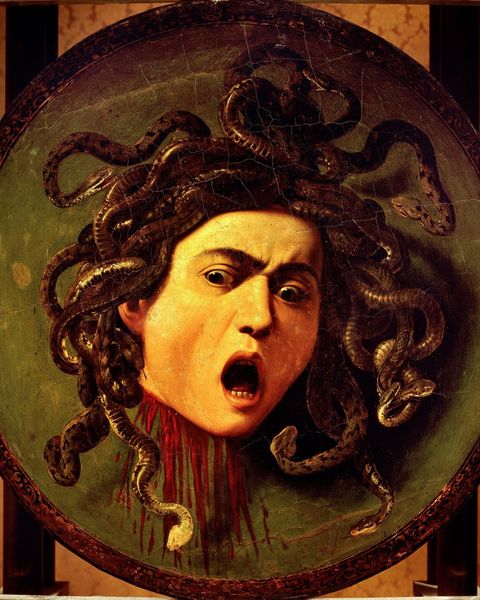
Medusa
Caravaggio · c. 1597 · Galleria degli Uffizi, Florence
What do you give a Grand Duke who has everything? That was the question Cardinal del Monte was asking himself in the late 1590s. He served the interests of Grand Duke Ferdinando de’ Medici, whose banking family had placed two popes in the chair of St. Peter and owned Donatello’s David and Botticelli’s Primavera and The Birth of Venus.
Del Monte knew how to ingratiate himself with those in power. Ferdinando thought of himself as a virile, manly leader. It is believed the family owned a painted Medusa shield by Leonardo da Vinci himself, and in 1545 Ferdinando’s father, Cosimo I, had commissioned the raffish Benvenuto Cellini to create the bronze Perseus now standing in the Loggia dei Lanzi. So del Monte placed his painter in an imagined competition with da Vinci: Caravaggio would paint Medusa’s severed head on a shield as a gift to the Grand Duke.
Caravaggio had a convex mirror to hand — like the one that turns up in his later . With it he could work out the distortions needed to set a face on a rounded surface, for this was painted onto a convex shield of poplar wood. He likely used live snakes taken from the Tiber (water snakes, not poisonous ones).
To hold this shield would be to become Perseus himself, just at the instant he decapitated the woman who turned men to stone. Graham-Dixon writes that Caravaggio sought to make the painting “transcend painting”: to become not a depiction of the shield but Perseus’s shield itself.
I find this the artist’s most unusual production: a shield as his canvas, the green background, and no other character, prop, or even a body.
The gift was delivered. Everyone won. The Grand Duke showed the shield off in his armory, del Monte presumably earned his thanks, and the painter was paid and earned some notoriety. In a troubled life, for once, all went well.
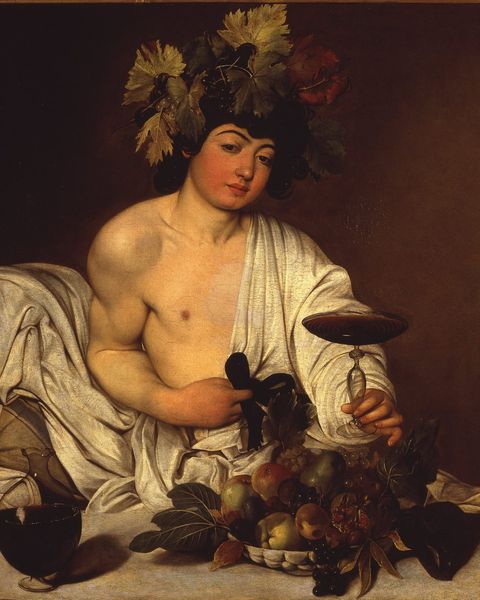
Bacchus
Caravaggio · c. 1596 · Galleria degli Uffizi, Florence
For more than three centuries, the Bacchus went unviewed, neglected, and unattributed. In 1913, an art historian, Marangoni, cataloguing the murky storerooms of the Uffizi’s basement, came across an unframed canvas darkened with dust, dirt, and soot. He initially suspected a brilliant copy of a lost masterpiece; his contemporary, the legendary critic Roberto Longhi, boldly identified it as the authentic original.
In 2009, experts using multispectral infrared reflectography looked beneath the paint, varnish, and grime. Within the glass wine carafe to the viewer’s left they found the tiny silhouette of a young man: Caravaggio himself at around 25, with dark, curly hair, holding a paintbrush and working at an easel. The naked eye cannot make out this picture within the picture.
This is a strange and unorthodox painting: the ancient god of wine set down in a sixteenth-century Roman room (note the striped mattress ticking on the pillow). Another gift from del Monte to the Medici, it is a tour de force. The basket overflows with ripe fruit — some bruised, some just starting to rot; some leaves verdant green, others browned.
Look at the glass. The wine being offered to us still ripples from the gesture, and small air bubbles ring the glass, transparent yet clearly solid. The boy’s eyes are moist, just as a viewer’s might be.
Caravaggio intertwines the classical with an almost comic presentation: the wine offered, fruit rotting, a bed sheet for a toga, and hair overly coiffured. Caravaggio’s sophistication may also suggest a memento mori (“remember that you must die”) — the vivacity of life in the young man’s offer of wine juxtaposed with the aging fruit and browning leaves.
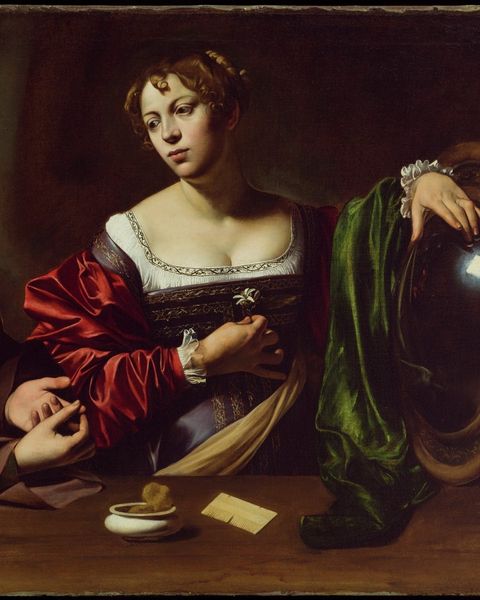
Martha and Mary Magdalene
Caravaggio · c. 1598 · Detroit Institute of Arts, Detroit
In the late 1590s, Cardinal del Monte was exposing his painter to an ever-widening group of friends. One was the Genoese banker and collector Ottavio Costa, whose will of 1606 describes a Martha and Mary very like this one. Costa also commissioned and my premier favorite, (c. 1604). He prized the Judith so highly that he kept it behind a silk curtain and, in his will, forbade his heirs ever to sell it.
Whether the painting ever left Costa’s hands, and when, is unclear; after the 1600s it all but vanished from the record. Its first recorded owners are the Panzani family of Arezzo. It was exported from Milan in 1897, and in the early 1900s the Argentine diplomat Indalecio Gómez bought it in Paris; it hung with his family in Argentina for decades. In 1971 they offered it at Christie’s in London, but it failed to sell at 130,000 guineas: not because Caravaggio was still forgotten — Roberto Longhi’s 1951 exhibition in Milan had restored him to the front rank — but because this canvas had only lately been accepted as his. Once the attribution held, the Detroit Institute of Arts bought it in 1973.
Unlike the suspended action of the London Supper at Emmaus (Session II), this is a view into a mind in the act of deciding. Martha is presenting her case for why her sister should change her wanton ways, ticking her points off on her fingers. The physically beautiful and enticing Mary is considering her choices.
We know where she will land just a minute from now. She has turned from the mirror, turned away from vanity, leaving a finger pointing toward a reflected divine light. She has abandoned the worldly possessions of her past life — the comb and the sponzarol, an alabaster dish with a sea sponge — pushed to the edge of the table. And the mirror we have met before: the very convex glass he is thought to have used for the .
The objects have already surrendered her old life; her face has not, quite. Her choice, I contend, is not yet irrevocable: you can see a woman weighing what is being said by someone she trusts. She gently twirls an orange blossom — in a painting a sign of purity and the bride to come, but its water and oil were also prized perfumes, sensual and faintly heady, so the same sprig breathes of the life she is leaving. Which way, which way, she asks herself.
The models were two well-known courtesans who recur across his art: Fillide Melandroni as Mary Magdalene and Anna Bianchini as Martha.
This painting follows Caravaggio’s deep conviction that religious experience is natural: no halos or angels, just two women in contemporary dress, conversing. Two sisters, a mirror, a flower, and the quiet gravity of choosing a different life. Who among us hasn’t had to contemplate a new path? How might we have looked while making that choice? Caravaggio shows us an answer.
In both the Renaissance and the Baroque, an artist who wanted to be truly successful needed powerful patrons. Botticelli had Lorenzo de’ Medici, Michelangelo Buonarroti had Pope Julius II, and the Cavaliere d’Arpino had Pope Clement VIII. An artist could also benefit from a circle of patrons: before moving to Rome, Annibale Carracci, his brother Agostino, and their cousin Ludovico were promoted and supported by three noble families in Bologna.
Del Monte would not be the only Roman patron of Michelangelo Merisi, nor was Costanza Colonna his only protector. A group of cardinals and church-affiliated bankers began to surround him. They would commission his works, collect and covet his paintings, and extricate him from many self-inflicted crises.
Cardinal Scipione Borghese was such an avid collector and admirer of Caravaggio that, in 1607, after the painter had fled Rome, he had Giuseppe Cesari (the Cavaliere d’Arpino) arrested on trumped-up charges of illegally owning firearms, and some 105 of Cesari’s paintings passed into the Cardinal’s hands. Included in the haul were two prizes, Caravaggio’s and .
Many of Caravaggio’s patrons would intervene with the authorities when the painter found himself under investigation or in the local jail. None could prevent the bando capitale, the death sentence, when Caravaggio killed a man in 1606.
An artist’s public notoriety could only follow public displays of his or her art. The place where an average Roman was most likely to see a painter’s work was in a church — a place Romans frequently visited for Mass, baptisms, weddings and confessions. For this reason, Caravaggio’s first church commission, which offered access to public exposure that could elicit praise or condemnation, was a moment of truth.
In 1518, Cardinal Giulio de’ Medici — the future Pope Clement VII — commissioned a grand national church for the French. The Palazzo Madama, the Medici palace and the future home of Cardinal del Monte, was just across the square.
Seventy years would pass before the church opened. San Luigi dei Francesi (the Church of Saint Louis of the French) was completed in 1589, and so it was rather new when Caravaggio began his career-defining work. It still serves as the official national church of France in Rome.
The Contarelli Chapel
San Luigi dei Francesi, Rome
Matteo Contarelli (the French Cardinal Matthieu Cointerel) had purchased a chapel and left a large endowment for its decoration. He was extremely specific about what he required:
“On the left wall, Saint Matthew inside a counting house … Saint Matthew, dressed according to the custom of his trade, is rising with the desire to follow Our Lord, who, passing through the street with his disciples, calls him…”
“On the right wall, Saint Matthew saying Mass, dressed in the vestments proper to that function, who is killed by a crowd of soldiers … and there should be a great multitude of men and women, young and old, praying, showing dismay and grief at the death of Saint Matthew…”
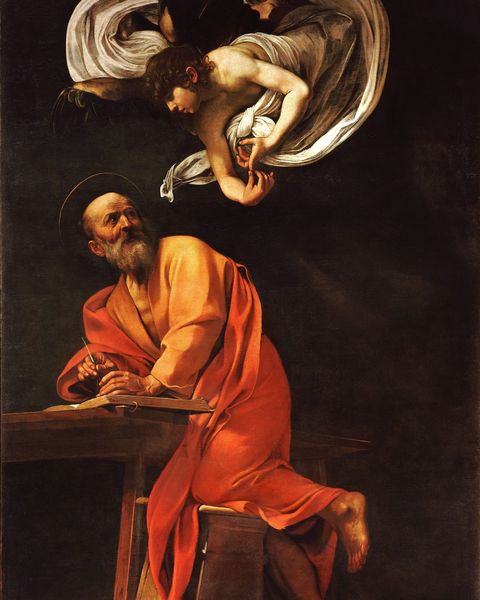
“Saint Matthew sitting in a chair with a book … in which he shows he is writing the Gospel, and next to him an angel, standing, who appears to be reasoning … or dictating what he should write.”
Contarelli died, and years went by with little progress. Then, on the eve of the holy year 1600, when French pilgrims would flock to Rome, no one wanted the French national church to be an unfinished eyesore. Whoever painted the chapel would have to do so quickly. Caravaggio was the lucky beneficiary of ticking time.
His old boss, the Cavaliere d’Arpino (Cesari), had painted the ceiling but was too busy to do the side walls. Cardinal del Monte, who had taken the young Caravaggio into his household, maneuvered the painter into the contract for the left and right side-wall paintings, staking his own reputation on a young man who had never attempted a public work of this scale and importance. So it would be this first public commission that would make Michelangelo Merisi famous throughout Rome.
It’s fascinating to stand in front of the chapel. Seeing three Caravaggios in one enclosed space unsettles you; unsure what to look at first, you glance forward, right, left, and back again. The paintings on the left and right are viewed at an angle, so they take a bit more effort to appreciate. And it’s important to consider the chapel’s actual natural light, from the window above the altarpiece.
This may be the world’s most revered Caravaggio location: three massive paintings hanging exactly where Michelangelo Merisi left them more than four centuries ago, in the place where he no doubt stood, just as visitors do today, looking at what he had accomplished.
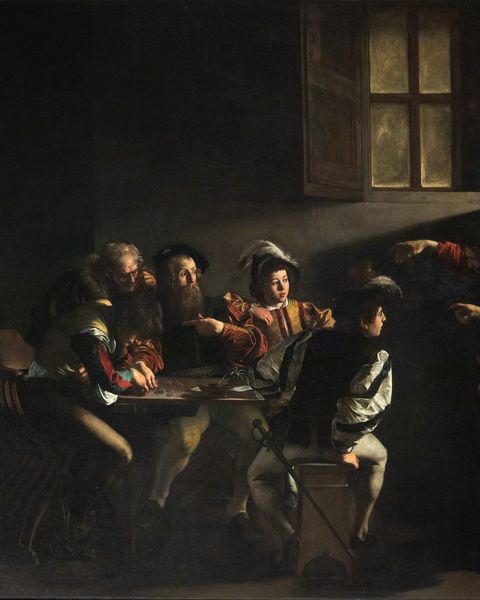
The Calling of Saint Matthew
Caravaggio · 1599–1600 · Contarelli Chapel, San Luigi dei Francesi, Rome
I hadn’t really experienced a painting this large, in situ, in the very place it was made for. It fills an entire wall, so the characters are near life-size. Much of the space is in darkness; all that matters is in light. Caravaggio aimed the light he paints on the canvas, above Jesus and onto those around the table, in a direction that mirrors the chapel’s real window, thus adding to the sensation of a real event before your eyes.
I understood that a story was being told, a story I wanted to believe. If a person is singled out in a crowd to accomplish something important, his life will change. He could matter. Caravaggio showed me something I had wanted for myself and did it through paint.
One of the attributes I admire most in Caravaggio is his ability to create a frozen moment in time. Jesus has stepped in to summon the tax collector Matthew as a disciple. He has spoken (his feet show he is starting to turn away), but his extended arm still hovers in the air, the hand (said to echo the hand of Adam in Michelangelo’s Creation of Adam) still pointed. We are in that breath of time just before it drops.
Paradoxically, the painter also creates motion within stillness. It isn’t Jesus, tucked behind Peter, that we first notice. The light, following the path of the window, illuminates each of those around the table in turn, and each is either starting to react, or just about to: the young boy looking directly at Jesus and Peter, Matthew responding to the call, the old man looking over the shoulder of the younger one, who is engrossed in the money, and the young man on the far right, sword at his hip, already swinging round on his stool toward the intruders.
But who at the table is Matthew? Many believe it is the old bearded man whose lit face seems to be asking: Who, me? You want me to go where? At times, however, I desperately want it to be the young man with his head down, lost in thought and failing to hear the call.
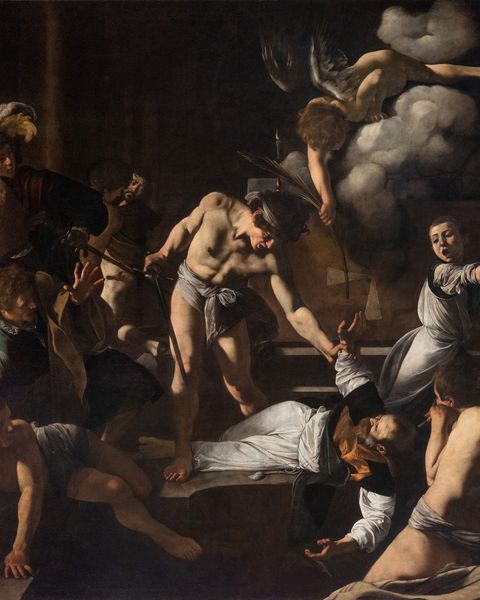
The Martyrdom of Saint Matthew
Caravaggio · 1599–1600 · Contarelli Chapel, San Luigi dei Francesi, Rome
On the right wall is the Martyrdom. It follows the traditional account that Matthew was slain while celebrating Mass at the altar by an assassin sent by the King of Ethiopia. Where set a new standard for Caravaggio in compositional complexity, this painting doubled it, with thirteen distinct characters.
X-ray evidence shows how hard he fought with this one. He started it in the crowded Mannerist style of his old boss Cesari, little figures swarming beneath grand architecture, then repainted the whole scene. Still unsatisfied, he set it aside to paint the , and only when he came back did he finish it in the stark light and shadow that was becoming his own. You are watching a painter invent himself under deadline.
The light focuses attention on the two primary actors. Matthew, in white vestments, fallen on his back on the step before the altar, is clearly doomed but in no way humble. The soldier displays the rage that would be necessary to butcher an elderly man. Matthew understands the role he is to play, and so he reaches toward the angel to grasp the palm of martyrdom.
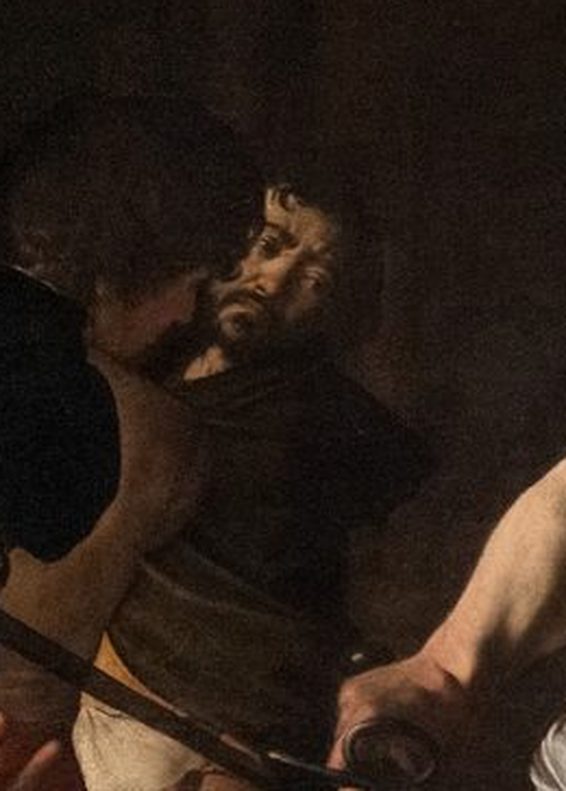
The other eleven figures have been described as moving outward like a centrifuge, adding to the chaos of a moment of murder. Are the naked men in the foreground there solely to provide depth, or are they people seeking baptism from Christ’s disciple? And who is that peeking over the killer’s shoulder? Caravaggio in a self-portrait? Something haunting is contained in this reading: he set his own face among the witnesses, looking back at the killing, years before he would flee Rome as a murderer himself.
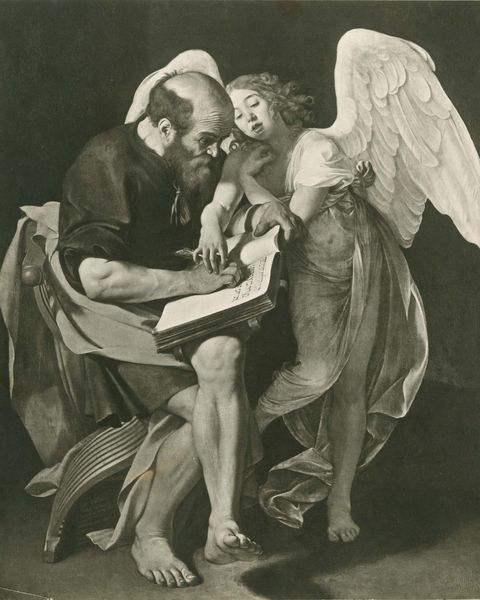
Saint Matthew and the Angel
Caravaggio · 1602 · first version, rejected · destroyed in Berlin, 1945 — known only from photographs
The original plans for the altar called for a marble statue by Jacob Cobaert. Cobaert delayed. When the statue finally arrived, it did not meet the requirements of the contract and, sitting between two new masterpieces, likely underwhelmed. Where to turn for an emergency altarpiece? The newly minted celebrity Caravaggio, of course.
His first attempt was rejected outright. Matthew was burly, and his bare foot would have seemed to hover over the altar. The angel is physically moving Matthew’s hand across the page, making one chosen by Christ look like a bumbling, illiterate old man. It was claimed at once by Caravaggio’s patron the Marchese Vincenzo Giustiniani, one of Rome’s great connoisseurs — a common, maybe all-too-common occurrence for Caravaggio, as we will see again with and the .
The painting was destroyed by fire in the final days of World War II. Ironically, it had been moved to a Berlin anti-aircraft tower for safekeeping. Black-and-white photographs let us compare the compositions, but we will never see its color or its brushwork.
The Inspiration of Saint Matthew
Caravaggio · 1602 · second version, accepted · Contarelli Chapel, San Luigi dei Francesi, Rome
His second attempt, which hangs there today, satisfied the critics, was accepted, and was installed. When you turn to face forward, this Matthew is almost calming. Gone is the drama of the and the centrifugal force of the .
Often, it seems to me, the critics of his day threw away something brilliant when they rejected his work. Here I am not so sure. The painter satisfied the naysayers by showing Matthew as an attentive listener; the angel keeps a respectable distance. While the second version is less intimate, it is more powerful. Matthew’s robe is a warm apricot or saffron, turning almost gold in the light; over it falls a cloak of deeper, more saturated red-orange, between scarlet and vermilion, that looks heavy to wear. The stool balances on its edge as Matthew twists to look toward the angel’s gesture.
The angel is counting down the genealogical line of Christ. Matthew is not only paying attention; I get the sense he is about to respond with a question. Caravaggio twists the saint just enough to convey an ongoing, active session with heaven’s instructor. With only two characters, the painting has a simplicity that distinguishes it from the side pieces.
I wondered if Matthew’s gaze might extend beyond the angel and into his sad future, and whether the angel might be catching sight of how the whole story began.
Santa Maria del Popolo · original built 1099, replaced 1477
When Caravaggio first entered Rome, almost a decade earlier, he had walked past Santa Maria del Popolo and likely gave it no thought. Now, riding the crest of fame generated by his accomplishments at San Luigi dei Francesi, he would produce two more extraordinary masterpieces.
The church sits directly inside the old north gate of Rome, on the Piazza del Popolo, adjacent to a hill where legend holds that Nero was buried and where a pope exorcised the emperor’s evil spirit.
This once-important Augustinian basilica, where Martin Luther may have worshiped before that whole thesis-nailed-to-a-door business, has a plain façade, so you are struck with wonder when you enter. In this one, simple church, you find not just Caravaggio (number 10 on the plan), but the Chigi chapel (number 6) with stunning mosaics designed by Raphael and statuary created by Bernini.
The Cerasi Chapel
Santa Maria del Popolo, Rome
The Caravaggios occupy the side walls of the Cerasi Chapel, redesigned around 1600 by Carlo Maderno, architect of the façade of new St. Peter’s Basilica. Visitors cannot enter the chapel itself, so the view is angled long in from the outside. The church, like hundreds of others in Italy, is owned by the state, yet entry is still free. Occasionally the lights go out, and someone must drop a euro coin into a metal box, affectionately known as a “miracle machine,” for new illumination. Free access doesn’t mean free viewing.
Tiberio Cerasi, Treasurer-General to Pope Clement VIII and so, not surprisingly, very wealthy, bought the chapel in 1600. The altarpiece was awarded to Annibale Carracci; to Caravaggio went Peter being killed and Paul blinded on the road to Damascus. After San Luigi dei Francesi, Caravaggio was the most talked-about painter in Rome.
The contract of 24 September 1600 survives in the State Archives of Rome. It grants the painter the freedom to execute the figures “in the way that shall seem most fitting to him, to the satisfaction, however, of his Most Illustrious Lordship…” But Caravaggio was asked to paint them on cypress wood, a surface he was not used to working on. Those first versions were rejected, and he was allowed to complete the project on canvas.
Carracci, his artistic competitor, finished his altarpiece before the second Paul and were completed. Carracci’s Mary, as the biographer Peter Robb puts it in M: The Man Who Became Caravaggio, is caught “breaststroking her way upward”; the whole composition, in his verdict, is thoroughly inane, all upturned eyes and plump cherubs. Caravaggio, in contrast, created the profound, all-too-human experience of silence. To look at the Carracci is to see the antithesis of what Caravaggio was attempting.
The Crucifixion of Saint Peter
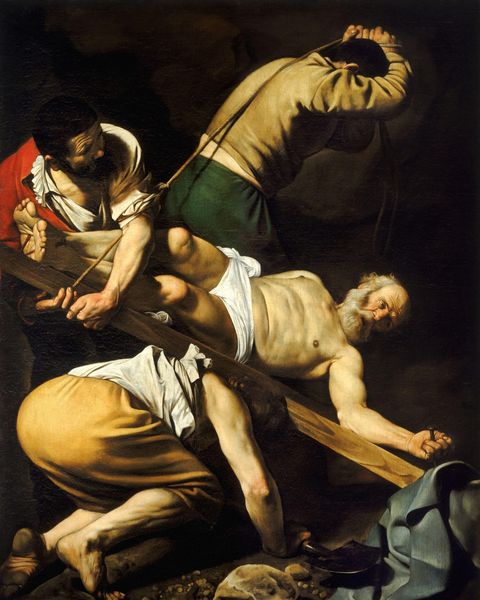
Caravaggio · 1601 · Santa Maria del Popolo, Rome
I react to Caravaggio’s paintings in a variety of ways: a very, very few with indifference, some with quizzical interest, a couple with uncomfortable concern, and most with awe and wonder. This one, and its companion on the opposite wall, fall into the last category.
It has been suggested that Caravaggio used Michelangelo’s fresco in the Vatican’s Pauline Chapel as inspiration. It too has a powerful Peter lifting himself to gaze out of the picture, and muscular workers straining to complete their task.
Look closely at Caravaggio’s version, and you will see a rocky outcrop in the shadowed background. This is sophisticated iconography. Peter was once Simon, and his name was changed to show that he would be the rock on which the church would be built. In Koine Greek, the Greek of the Christian Bible, both Petros (Πέτρος) and petra (πέτρα) translate as “rock” or “stone.”
The three workers are somber and methodical: the masons, carpenters, and tanners of Caravaggio’s neighborhood, right down to the grubby soles of their feet and the straining of their backs. They are just doing their jobs, laboring to lift the heavy cross and the man nailed to it. Caravaggio not only honors the laborer with a place on the canvas but tells a story that they, or any merchant, notary, or parish priest, might better understand. I heard someone say that the painter had a unique ability to generate a viewer’s empathy for all the characters in a painting. This is true for The Crucifixion of Saint Peter.
Peter’s face is the most realistic and convincing of any I have seen. His is the only clearly visible face Caravaggio wishes to show us. Peter has chosen to be crucified upside down, judging himself unworthy of a death like Christ’s: a sturdy old man, resigned to his fate and committed to his faith. Some say his gaze falls on the altar, the place where the sacred transubstantiation of bread and wine into the body and blood of Christ will be performed.
Caravaggio brings us, in stark reality, a theatrical tableau of faith, self-awareness, and courage.
This is a liminal space between a life lived and the certainty of death. It is a space that we all will inhabit for whatever period of time.
The Conversion of Saint Paul
Caravaggio · 1600–1601 · Santa Maria del Popolo, Rome
The second painting in the Cerasi Chapel — more appreciated by many than the — hangs to the right of the altar. This is Saul, later Paul, not quite, I think, at the moment of his conversion, but seconds after it. It’s as if the conversion, in a blinding illumination, has already happened, and now the light begins to recede, leaving Paul almost ready to begin his new mission.
Raphael had dealt with the conversion in tapestries now in the Vatican Museums, and Caravaggio might have developed some of his staging there; Raphael’s Paul lies on his back, arms outstretched, a sword at his side. But Caravaggio followed his own road. His Paul has his eyes closed; the saint is experiencing the miracle within himself, not as a production before other actors. No deity stands nearby, beaming rays of light upon him.
In Caravaggio’s version, the first thing you notice is a large, mottled horse’s rear end, almost jutting into your space, a commonality with the worker’s rump on the opposite wall. The groom is barely aware that anything is happening. He and the horse are in their own world, excluded from what is a purely personal drama. Paul, the groom and the horse are all silent, each lost in his own thoughts.
Paul’s helmet is about to tumble from the frame into our own world. Caravaggio often merges the world of the story inside the painting with the world looking upon it; consider the precarious stool leg in , and the basket of fruit in , still to come.
Caravaggio, the master of the slashing bright light, lets Paul experience its fading warmth: a man in darkness brought into the light, a parable for Caravaggio’s own painting style.
Peter and Paul together tell an important story of life. In one, an old man sees his end; in the other, a young man cannot yet see, but certainly knows, that a new one has begun.
No one who has spent time reading about and studying the mercurial Caravaggio has any doubt that the man was troubled, violent, and self-absorbed. A few even describe him as a sociopath. True as these adjectives may be, Caravaggio also lived in a violent age.
In the generation that followed, other great artists had their own troubles with the law. Francesco Borromini, the architect, needed a papal pardon after he ordered a man he caught damaging a piece of marble to be beaten. The man died from his wounds.
Gian Lorenzo Bernini, the sculptor and darling of popes, discovered that his brother was having an affair with the woman Bernini himself was sleeping with, and promptly broke his brother’s ribs with an iron bar. Not content, he sent a servant to the woman’s house to slash her face with a razor.
What makes Caravaggio’s personal history so tragic is that his crimes spanned his adult life and spiraled into ever more violent behavior.
A story circulates that Michelangelo Merisi left Milan to escape the law. The early biographer Giulio Mancini, a physician who knew the painter in Rome, hints at a violent quarrel there, and later writers repeated the tale, some adding a year in prison after a street brawl that left a man dead. No Milanese court record has yet been found to confirm it.
Rome is another matter. The copious Roman legal records show:
May 1598: arrested for carrying a sword without a permit near Piazza Navona.
November 1600: just as he was coming to be considered the greatest painter in Rome, he was sued by a man who alleged that the painter had beaten him with a stick and torn his cape with a sword.
February 1601: Flavio Canonico, a sergeant of the guard at Castel Sant’Angelo, accused him of wounding him with a sword.
September 1603: arrested and imprisoned in Tor di Nona after the rival painter Giovanni Baglione sued him for libel. Caravaggio and his friends had written and circulated crude, satirical verses mocking Baglione’s work. He was released after about two weeks, through the intervention of the French ambassador.
April 1604: a waiter at the Osteria del Moro, near the church of the Maddalena, filed an assault complaint after Caravaggio hit him in the face with a dish of artichokes, following an argument over how they had been cooked.
October 1604: arrested for throwing stones at Roman police officers near Via dei Greci.
May 1605: arrested on Via del Corso for illegally carrying a sword and a dagger.
July 1605: arrested for defacing the house of a woman named Laura della Vecchia, likely in retaliation for an insult.
July 1605: the notary Mariano Pasqualone accused Caravaggio of striking him on the head from behind during an argument over the courtesan Lena. Caravaggio fled to Genoa for several weeks until the matter was settled.
September 1605: sued by his landlady for unpaid rent; he stoned her windows at night.
October 1605: found in bed at a friend’s house, wounded in the throat and left ear; he said he had fallen on his own sword.
Keep in mind that these incidents come primarily from court records. We receive the testimony and comments of court officials, victims, and witnesses. What we rarely have, beyond the quote that began this session and a few lines of testimony, is Caravaggio’s own voice. I don’t mean to suggest that he wasn’t a violent perpetrator or that his actions could be explained away. Rather, as perspective is to painting, so it can be to history: here we have an incomplete depth of view.
How did he avoid long imprisonment? Through the influence his protectors could exert on his behalf. Rome was the capital of the Papal States, the Pope’s own realm, and its legal system answered to the Church. High-ranking clerics and wealthy church patrons had enormous sway over the police and the courts. Caravaggio was protected — until he couldn’t be.
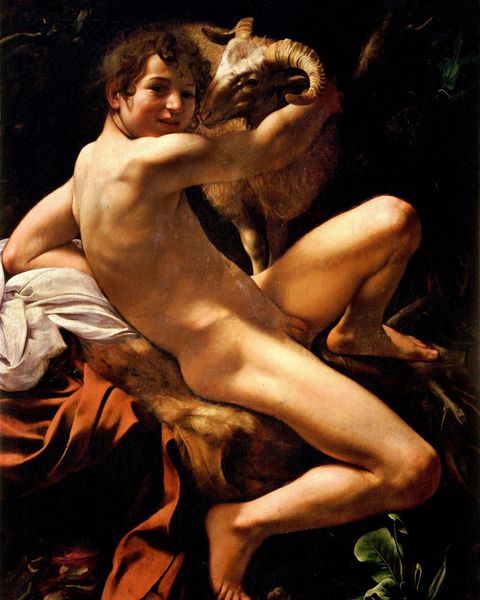
Caravaggio had moved from del Monte’s palazzo to that of the Mattei brothers. This painting was commissioned by Ciriaco Mattei, brother of Cardinal Girolamo Mattei. Ciriaco would commission two more: The Taking of Christ (Dublin) and the Saint John the Baptist (Youth with a Ram) I, now in Rome’s Capitoline Museum. It was a different world from his earliest years, sleeping on straw, eating lettuce, and painting popular subjects for the spacciatori, the picture dealers.
What became of all the money he was earning is a mystery. He owned no property, we know of no business he was invested in, and he was a party boy, sure, but there is only so much wine to drink and artichokes to eat. The one indulgence we can document is clothing: by Bellori’s account, he bought the costliest silks and velvets, then wore each suit until it fell from him in rags. So much of his life mirrors his tenebrism — one aspect brightly lit and another shrouded in darkness.
In this painting, you can almost see the instant in which the two disciples recognize Christ. The left hand jutting out, the fruit balancing precariously at the table’s edge, the arms bending to raise a body from the chair — all of it creates action suspended, somehow, in permanence. The meal is set not in the Holy Land but in a typical Roman tavern, and still life replicates life with all its imperfections; an apple seems to have a wormhole.
Those who look closely point out that the basket’s shadow creates the image of a fish’s tail, the fish being a potent symbol of Christianity, and that two strands of weaving in the basket again form the Ichthys. I most appreciate Caravaggio’s secular messaging, but I marvel at how he can literally weave in a theological reference.
While Caravaggio was a genius, he wasn’t perfect. His use of perspective didn’t always conform to the rules of painting. The painter David Hockney points out that the disciple with the shell pinned to his chest has a right hand slightly larger than his left. The proper use of perspective would make the hand farther from us the smaller. The biographer Graham-Dixon argues that here it is purposeful rather than a flaw: the larger, blurred hand creates a sense of motion.
This is one of two versions; the second, in the Brera in Milan, is a very different and far quieter picture, painted five years later while he was on the run. We’ll meet it in Session III.
If I could own three of the master’s paintings, this would be one.
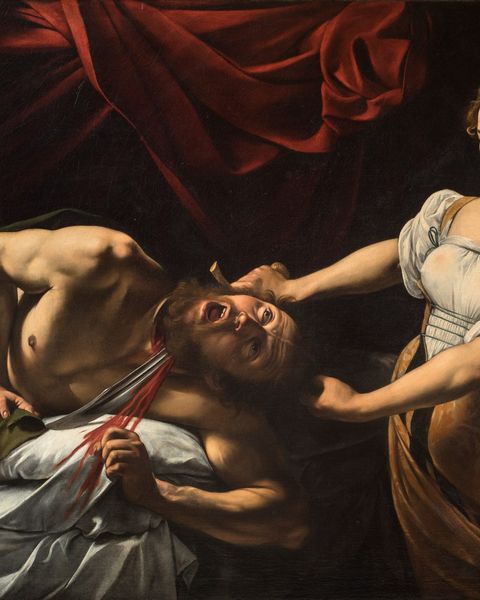
Judith and Holofernes
Caravaggio · c. 1602 · Palazzo Barberini, Rome
Through Cardinal del Monte, Caravaggio met the banker Ottavio Costa, the patron behind this painting and my premier favorite, , now in Kansas City. By 1602, he had already begun a dramatic transition from the soft and sweet , , and to something darker and violent.
Judith was a common Renaissance subject: a young widow who, to save her people, beguiles and then kills General Holofernes. Artemisia Gentileschi, daughter of Caravaggio’s buddy Orazio, used the motif to exact some revenge, painting herself as Judith and the man who raped her, the painter Agostino Tassi, as Holofernes. It was difficult for a woman to bring charges, but her father could. The all-male Roman court subjected her to a cross-examination that included thumb screws – just to be sure she wasn’t making it all up. Tassi was convicted and sentenced to five years’ banishment, then pardoned. Artemisia made sure it was not forgotten.
Caravaggio went all-in by showing the act of violence itself, at the very moment the victim understands he has lost both his life and his head. He introduces the old woman, who will become a recurring character, and keeps his ever-present red drapery.
The model is Fillide Melandroni, a local courtesan we saw in . His portrait of her, like the first Matthew altarpiece, was destroyed during World War II. Casting Fillide, a woman Roman men paid for sex, in contemporary dress, as the woman who kills a powerful man in his bed, gave Roman viewers something to consider. Fillide was no stranger to violence herself; a fellow prostitute testified, “The said Fillide came at me with a knife to disfigure me, and she hauled me up by the mouth to give me a scar.”
Her presence, as Andrew Graham-Dixon describes it, moves this painting from the sacred into the profane — from profanus, “outside the temple,” meaning simply secular.
Caravaggio’s Judith is not the strong, confident woman Artemisia would later paint. She looks almost clumsy with this foreign task, her knitted brow suggesting she isn’t quite sure what to expect. She is, however, serious. Her left hand grips the general’s hair, pulling the head away from the body.
The painter seems to suggest that the adrenaline rush Judith must be experiencing triggers some degree of sexual arousal, as we see in the fabric of her bodice. Is he attempting to make this dark scene even more disturbing with a darkly erotic addition?
It is Judith’s knitted brow, the one that will appear on a pasta sauce label some four hundred years later, that I find most compelling. It is an expression common to all of us, one born of a necessary yet difficult and confusing task.
“I don’t know what to say except that it is too natural.”
Annibale Carracci (1560–1609), Caravaggio’s contemporary, on the painting
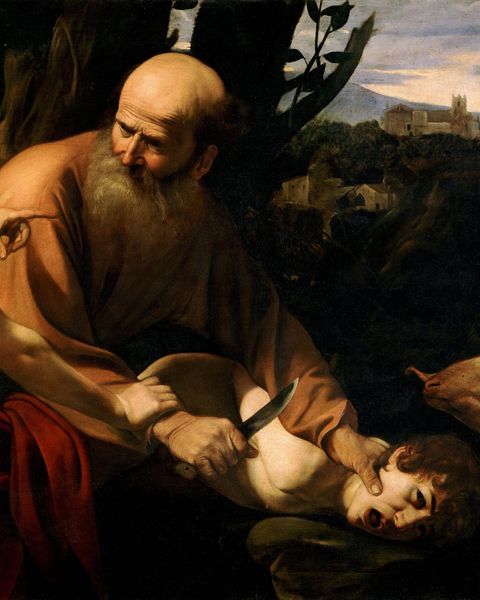
The Sacrifice of Isaac
Caravaggio · c. 1603 · Galleria degli Uffizi, Florence
One might expect that the painter’s troubles with the law were all about fighting. Not so. Around this time Caravaggio spent two weeks in jail for libel against his competitor, Giovanni Baglione (see Troubled Times). He and a few friends (including Artemisia’s father, Orazio) had been reciting disparaging doggerel about Baglione all about town. One verse, punning on his name, ran: “John Bags, you haven’t a clue that your paintings are woman’s-work... take your drawings and your cartoons that you have made... and wipe your ass with them...” The greatest painter of the Baroque was no Christopher Marlowe.
His connections held once more: the French ambassador had him moved to house arrest. The French had reason to look after the painter of their own national church’s Saint Matthew cycle.
The trial gives us Caravaggio’s only recorded philosophy on art. Asked by the judge what made a great painter, he said: “In painting, a valent’huomo [man of worth] is one who knows how to paint well and imitate natural objects well.” Not much for us today, but it certainly confirms his focus on the natural.
This version, one of potentially two, was done in 1603 for Maffeo Barberini, the future Pope Urban VIII.
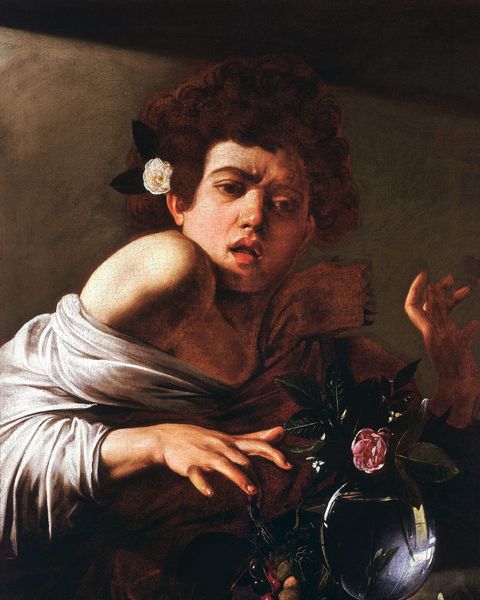
There is much that is “natural” here. Isaac’s expression is one of genuine fear; we see echoes of in his open mouth. The landscape in the upper right would be the last time Caravaggio ever included a horizon. With the , it is one of the very few landscapes he ever painted. I have stood before this painting three times, and on each occasion, I find myself curious about the angel. His face seems to mimic the ram he points to, and the ram himself looks back with a worried expression. There is a discomforting symmetry between the two.
I appreciate this painting for all its disturbing realism. Abraham is ready to set aside his humanity — and his son — to follow his God. One can almost hear Isaac cry for help. The father’s knitted brow, the thumb pressing on the cheek, and the strength of the hand holding the blade make me wonder whether the painter was extolling a biblical story or condemning it.
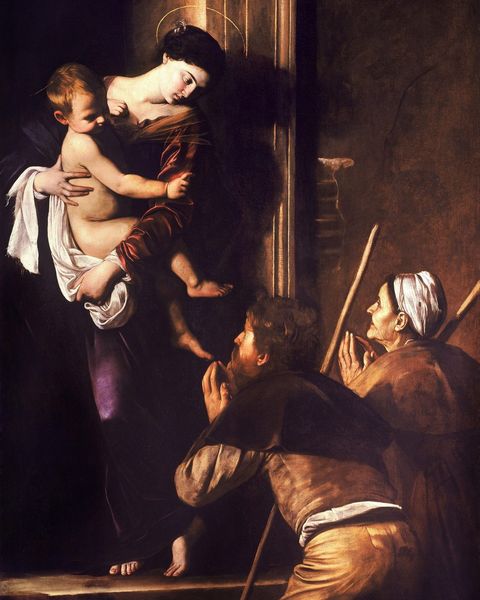
Madonna di Loreto
Caravaggio · 1604–06 · Chiesa di Sant’Agostino, Rome
I believe Caravaggio can inform and inspire those of deep religious faith. His unique skill is that he can also move those of us who do not share it. In this painting, I see a core tenet of Baruch Spinoza (1632–1677) – to love one another. Spinoza, a philosopher I admire, was another brilliant rebel who died young and was condemned as a blasphemer.
The Cavalletti family commissioned Caravaggio in 1603 for their chapel, requesting the Madonna of Loreto: a wonderfully fanciful account in which angels lifted the Virgin Mary’s house in Nazareth into the air and set it down in Loreto, Italy. Who wouldn’t want to see a flying house? Caravaggio was instructed to show Mary welcoming pilgrims. Then he did the most Caravaggio thing he could do.
No clouds, angels, or sunlight. A barefoot woman stands in an actual Roman doorway, chipped, its plaster fallen, holding a plump child like any harried mother. Her visitors look like the most common pilgrims. The man’s feet aren’t just dirty; they are grimy and marred. The woman’s wrinkled hands could not be frailer. These are people we could see in an area of our city we infrequently visit, should we choose to look. Caravaggio makes us see them, and we may be a bit humbled.
John Berger, in a 1983 essay titled “Caravaggio: A Contemporary View,” wrote:
“He was the first painter of life as experienced by the popolaccio, the people of the back streets, les sans-culottes, the lumpenproletariat, the lower orders, those of the lower depths, the underworld. Interestingly enough, there is no word in any traditional European language which does not either denigrate or patronise the urban poor it is naming …”
John Berger, “Caravaggio: A Contemporary View,” 1983
This time the public could cackle alongside the cognoscenti and the clergy. The model was almost certainly Lena — Maddalena Antognetti, another courtesan. The parishioners of Sant’Agostino saw a woman they knew, or had gossiped about, on the wall of their church as the mother of God. Caravaggio could not have cared less.
I recently read that when he saw an exterior door of Sant’Agostino to the painting’s left, he brightened his whites to better catch the light when the door opened.
Once again he bridges the sacred and the profane, turning a religious narrative into a street scene of the living Gospel. The baby would later preach, “Blessed are you who are poor, for yours is the kingdom of God. Blessed are you who hunger now, for you will be satisfied. Blessed are you who weep now, for you will laugh.” (Luke 6:20–21) Although they snickered about the model, those neighbors knew they were the ones to be blessed, for they were Rome’s poor, hungry, and weeping.
“The entire law [that is, the divine law] consists in this alone: to love one’s neighbor…”
April 1604: Caravaggio was having lunch with two friends at the Osteria del Moro (a popular tavern near the church of the Maddalena) when he ordered a plate of eight cooked artichokes — four prepared in butter and four fried in oil.
The waiter brought the meal, and Caravaggio asked which was which. The waiter replied, “Smell them, and you will easily tell.”
Caravaggio was continuing some dark, downward spiral, and this flippant response lit a fuse. The police report reads:
“About 17 o’clock [lunchtime] the accused, together with two other people, was eating in the Moor’s restaurant at La Maddalena, where I work as a waiter. I brought them eight cooked artichokes, four cooked in butter and four fried in oil. The accused asked me which were cooked in butter and which fried in oil, and I told him to smell them... He got angry and without saying anything more, grabbed an earthenware dish and hit me on the cheek... and then he got up and grabbed his friend’s sword... intending perhaps to strike me with it, but I got up and came here to the police...”
The waiter’s statement to the police, April 1604
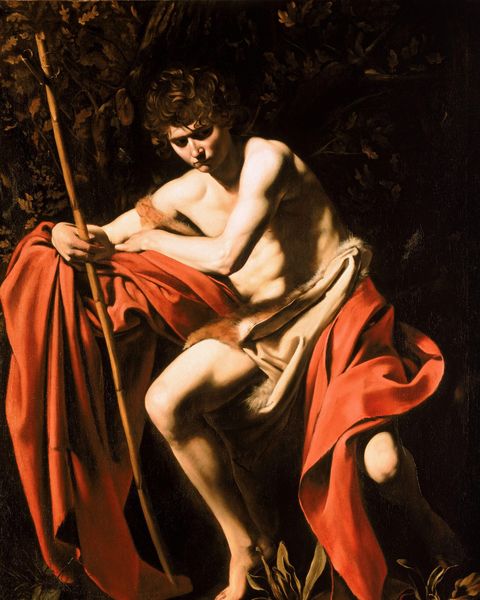
Saint John the Baptist in the Wilderness
Caravaggio · c. 1604 · The Nelson-Atkins Museum of Art, Kansas City
This was the first actual Caravaggio painting I ever saw. I saw a young man, as I used to be, with all the promise of youth but carrying the weight of responsibility. How would his life evolve? Would he make a difference in the world he occupied?
What Caravaggio offers is the light — from the left, almost like a lightning flash — that does as much with shadow as with illumination. The darkness on John’s face tells us he is troubled, brooding, lost in thought; his slumped posture and furrowed brow suggest the immense and lonely weight of his future mission.
In this very catholic (as in universal) painting, he eschews convention: no halo, no scroll, not even the lamb. The foliage is spare, though Caravaggio could paint nature exquisitely when he chose; the painting is better for it. You’re left looking at what appears to be simply a boy. Then again, not just a boy, but a young man of strength, thoughtfulness, and, through the robust drapery, an indication of nobility.
It was likely painted around 1604 for Ottavio Costa, and stayed in Italy for most of its existence. By 1910 it was in England. Later, in London, a dealer showed it to Milton McGreevy, a Kansas City museum trustee traveling with his family, and he instinctively knew it was profound. The National Gallery in London hesitated; McGreevy, working with the William Rockhill Nelson Trust, did not. The 1952 price of £30,000, about $84,000, is considered a bargain today. This John would likely command $100 million or more.
Nicolas Poussin (1594–1665), the leading French classical painter of the century, spoke of Caravaggio with contempt. According to Poussin’s biographer, he charged that the man “had come into the world to destroy painting.” Caravaggio, I suspect, would have agreed, and gladly. A revolution, almost by definition, destroys what came before. He wanted a brush in his hand and a living model before him. He had a new way of seeing, and only disdain for anyone who couldn’t see it with him. That meant putting the poor with their dirty feet into sacred scenes, showing the mother of God as a tired woman and even a corpse, and showing the Baptist as a deeply introspective young man.
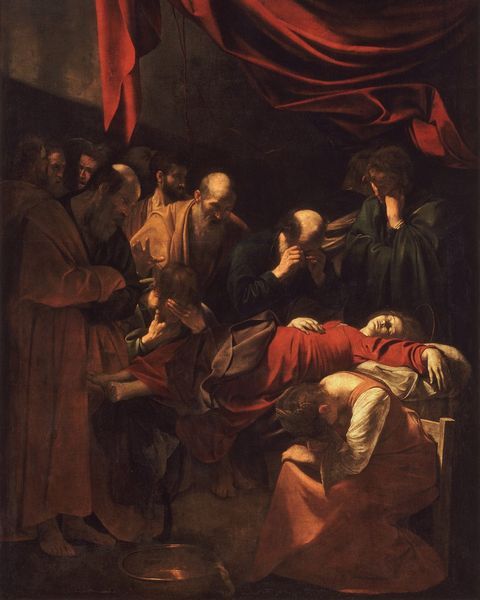
The Death of the Virgin
Caravaggio · 1605–06 · Musée du Louvre, Paris
The painting is colossal: an altarpiece, commissioned in 1601 for Santa Maria della Scala in Trastevere, at just over twelve feet tall. Some said he had to knock a hole in his studio wall to get it out; that story may have come from a lawsuit in which a frustrated landlady alleged he had hacked a massive hole in the ceiling of his rented studio.
He worked on it for years. When presented, it was rejected, and the Carmelite fathers had it removed. Later writers explained why. His rival and early biographer Giovanni Baglione (Johnny Bags) complained that the Madonna was painted “with little decorum, swollen, and with bare legs”; Bellori, writing later still, said Caravaggio had imitated a swollen dead woman far too closely.
Where the good fathers saw blasphemy, those with a discerning eye saw genius. Peter Paul Rubens urgently recommended that his patron, the Duke of Mantua, buy it, and the Duke did. Before it left Rome, the city’s painters demanded to see it, and in April 1607 it was displayed for a full week to enthusiastic crowds. It later passed through the collection of King Charles I of England and, after his execution, through the banker Everhard Jabach to Louis XIV.
Painters had always softened the Dormition: a serene Mary falling asleep, borne up by angels through the clouds. Caravaggio would have none of that. His model was a real woman from the neighborhood, looking as if she had been fished from the Tiber. No trumpet-blowing angels, no angelic light; her arm hangs uselessly to the side, and the mourners are weeping bald men who could be any peasants of Rome. Andrew Graham-Dixon finds her body heavy with “a sense of sleep, sex, birth, and death.”
Standing in the crowded hallway of the Louvre, I was looking at genuine sadness, the kind that overtakes people when someone they truly love dies too early, a grief so hard to share that we cover our faces, even in a crowd. The first thing I noticed was not Mary’s face but her abandoned hand. It hangs over the edge of the bier with an unsettling weight that no reproduction ever prepared me for.
I believe Caravaggio knew that death was too important to be minimized by myth. After all, think of what he experienced in Milan during the plague years. He may have had faith in the immortality of the soul, but he knew from experience that the body begins to change the instant it no longer holds the person so loved. What the critics saw as vulgar, I see as profound spiritual empathy.
Madonna dei Palafrenieri
Caravaggio · 1605–06 · Galleria Borghese, Rome
The painter seemed to be spiraling. Locked out by his landlady, he threw rocks at her windows. In October 1605 the authorities found him in bed at a friend’s house, seriously injured in the throat and left ear. All he would say, in Graham-Dixon’s translation, was, “I wounded myself with my own sword when I fell down these stairs … there was no one there.” Falling on his own sword, figuratively or literally, was not a Caravaggio trait.
This was a hugely important commission. Placing a religious painting in a parish church to be seen by the public was one thing; to be hung in the basilica that represents the heart of Roman Catholic power was another. Caravaggio would be placing his art in Saint Peter’s, the most important church in Christendom.
In late 1605, after the final sections of the old Saint Peter’s Basilica were demolished, the altar of the Arciconfraternita dei Palafrenieri — the archconfraternity of Papal Grooms — dedicated to Saint Anne, was moved to a more important location in the transept of the new building. The Grooms were high-ranking attendants to the Pope. Caravaggio was awarded the new altarpiece in late October 1605, with his first payment on December 1st. He moved rapidly. The painting was installed on April 14, 1606, and then, two days later, on the 16th, removed and briefly reinstalled in a nearby church dedicated to Saint Anne. It wouldn’t remain there long. Cardinal Borghese arranged to acquire it for his own collection, paying 25 scudi more than Caravaggio received. It seemed the Papal Grooms had denied our painter a spot in Saint Peter’s and executed a flip, pocketing the cash.
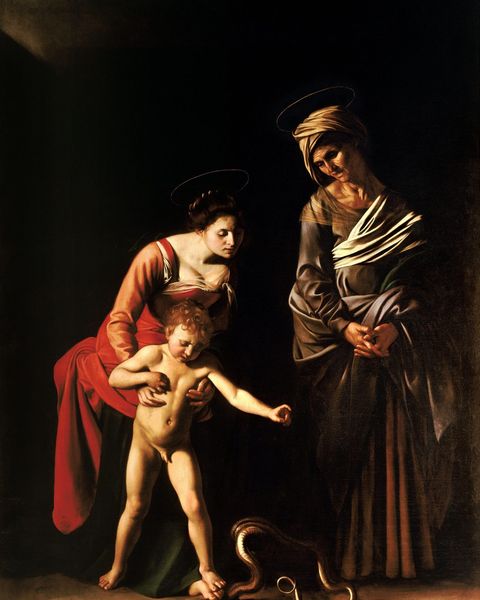
The Roman Church — as if there weren’t other questions to solve, like those that had sent Giordano Bruno to the stake in 1600 — spent much energy debating whether it was “he” or “she” that “will crush your head” in Genesis (3:15). Was it ipse or ipsa? The translators of the 1611 King James Version sidestepped the question with “it”: “And I will put enmity between thee and the woman, and between thy seed and her seed; it shall bruise thy head, and thou shalt bruise his heel.” The one who crushes the serpent is the woman’s seed, a man, and not the woman of the Vulgate’s “ipsa.” Caravaggio followed the then-agreed story: Mary crushes the head through her son’s power, with her mother, Anne, in support.
The painting shocked its first viewers. Mary’s décolletage, a naked toddler Jesus’s penis, Saint Anne’s haggard look — everything was too old, too human, too carnal. The Council of Trent had insisted on decorous art, and this clearly was not. In Ambrogio Figino’s Madonna of the Snake for San Fedele in Milan, about twenty years earlier and a painting Caravaggio might well have seen, everyone is decorously clothed.
Why was this painting so quickly rejected? Were the crusty traditionalists so offended by the Virgin in common contemporary dress, breasts pressing forward, and the toddler’s penis that they covered their faces in shame? Possibly; their chapel was, after all, in Saint Peter’s. Art historian Rocky Ruggiero says in his podcast that this is the first presentation of the Virgin’s cleavage in history. Of course, a quick alteration could have covered that chest and that penis. Caravaggio had, after all, replaced the rejected with a more decorous one. Or was it an elaborate plot by the genuinely unscrupulous papal nephew to acquire the painting? Maybe.
In 1642, the rival and biographer Giovanni Baglione recorded only that it was taken down from the altar of Saint Peter’s by order of the Cardinals. A cardinal’s secretary is said to have been blunter: “In this painting there is nothing but vulgarity, sacrilege, impiousness, and disgust.”
In a podcast, the author Marie-Anne Mancio offers a simpler, and I think more reasonable, answer. The Grooms were offended that their patron saint, Anne, was relegated to the sidelines looking like a haggard crone, playing no part in the drama.
What was Caravaggio intending to say with Anne? To me, she seems ghoulish. Her shadowed eyes dehumanize her. Looking down at her earthly grandchild, who is also her God, she expresses no warmth, pride, or even amusement. If I looked at my grandchildren in that way, they would bolt in terror. Frankly, if I were a Groom dedicating an altar to Saint Anne, I would have sent the painting back just as quickly.
It is my opinion that the double rejections of and sent Caravaggio far off the ledge. He had to know was one of his greatest works, monumental in size, sophistication, and execution. The should have hung over an altar in the world’s most important church, visible to millions for a thousand years. But the ignorant, pompous churchmen, men who failed to grasp the truth of life or faith, had rejected him.
Whether Michelangelo Merisi da Caravaggio was an egotistical, narcissistic sociopath or simply an insecure man with some mental health issues, this was all too much.
was ordered removed on April 16, 1606. On May 28th, he would kill a man.
The man who was all the rage was overcome by rage.
On May 28th or 29th of 1606, Ranuccio Tomassoni died from a sword wound to the upper thigh, administered by the painter, Michelangelo Merisi da Caravaggio. They had fought on a tennis court near the Campo Marzio, on today’s Via di Pallacorda — Tennis Street.
Tennis in seventeenth-century Rome was an aristocratic endeavor, played on a walled court divided by a net. I imagine it to be a cross between tennis, handball and squash.
The popular version was that they argued over a tennis point. Andrew Graham-Dixon’s detailed biography argues another scenario: this was a duel that turned into a gang fight with four thugs on each side.
With Caravaggio was his buddy, Onorio Longhi, a Milanese architect and local rabble rouser, and two military types. Tomassoni wasn’t alone either; there was plenty of family muscle, including his brother Giovan.
Ranuccio’s murder was a bridge too far for papal authorities and Caravaggio’s protectors, and he knew it. He fled Rome, heading to the Alban Hills southeast of the city. He would never again return, although he tried desperately to find a way back.
In absentia, the painter was condemned as a murderer and subject to the bando capitale — any citizen in the papal states could kill him and receive a bounty. A bounty hunter didn’t need to bring in his corpse, just his head. His head would return to Rome, just not in the way the authorities expected.
Over the next four years, Caravaggio would move south and then back north, always hoping for a papal reprieve.
Along the way he painted constantly: commissions from the powerful and from church officials, paintings meant to win over someone who could help, and, occasionally, paintings that might just be currency for the next infusion of cash.
The Alban Hills
Michelangelo Merisi knew things were bad. But not all his support had vanished. He still had his guardian angel, Costanza Colonna, and he must have known that even if he personally wasn’t welcome in Rome, his paintings were still admired by the cognoscenti.
When Caravaggio fled Rome he took refuge in the Colonna estates, which bordered the Aldobrandini lands around Carpineto Romano. There, in the Alban Hills made famous by Virgil in the Aeneid, he painted a Saint Francis.
“But Juno, looking forth from the summit of the hill which is now called Alban—though at that time the mount had neither name, nor grace, nor glory—surveyed the plain, and both the armies, of Laurentum and of Troy, and the city of Latinus.”
Virgil, the Aeneid
Saint Francis in Meditation
Caravaggio · c. 1606 · Palazzo Barberini, Rome
In 1968, an art historian visiting the village of Carpineto Romano found a dirty, grimy painting literally nailed to a church’s wall. Later investigations confirmed it to be an autograph Caravaggio, very likely the first version of Saint Francis in Meditation. A near-identical version hangs in Rome, and scholars still argue over which came first.
The church where it was hung, San Pietro Apostolo, was founded and supported by Cardinal Pietro Aldobrandini, nephew of Pope Clement VIII. A gift from a painter on the lam to a powerful Cardinal makes some sense.
Cardinal Borromeo would have been proud: this Francis displays the humility and poverty he was known to embrace. His robe is ripped and tattered, and his face and hands are rough and natural. But it is also very conventional. There is no story here. Francis could have been kneeling there all day, thinking.
Biographer Peter Robb makes the point that John the Baptist, Saint Francis, and Saint Jerome form a recurring trio of solitary men — young, mature, and old — each turned inward and apart from the world. Caravaggio painted them again and again, until they became something like personal touchstones for his own troubled life.
I can imagine the painter himself contemplating death, solitary and haggard. I understand how time brings us inward: in youth we engage, even try to conquer, the world around us; with age comes the sense that the world most worth reconciling is the one within.
Supper at Emmaus II
Caravaggio · 1606 · Pinacoteca di Brera, Milan
In 1606, William Shakespeare was writing Macbeth, a tale of murder and mayhem. Galileo Galilei was teaching mathematics in Padua and making brass compasses on the side. Francesco Borromini, the great Baroque architect, was just turning seven. Michelangelo Merisi da Caravaggio was on the run for murder.
Still in the Alban Hills under the protection of the Colonnas, he painted a second Supper at Emmaus. This one is strikingly different.
Biographers point to the beheading scenes he painted as a fugitive; my armchair psychoanalysis goes to this painting. When compared to the London version, I see a totally different painter.
I see consummate skill and genuine gentleness, but I also feel claustrophobia, the enveloping shadows of his life. The clean-shaven Christ of the London version is replaced by a more careworn, slightly bearded figure sitting in half light. It seems almost like a struggle for him to lift his hand. There are no great exclamations from the apostle on the right.
The color palette has become more subdued. Gone is the white in Christ’s clothing, the deep blues and saturated reds; now it is all ochre and muted browns. The background wall in the London version is light enough to allow for a shadow; here, all is shadow.
There is a sparse table now, and a newly installed weathered old woman. And yes, the observer on this side of the canvas has also aged, become a bit more weathered and a bit slower to lift his hand, since he first encountered the Supper at Emmaus I in 2017.
The earlier 1601 version was done when the painter was riding high, fresh from the Contarelli and Cerasi chapel masterpieces. He painted that recognition scene with theatrical bravado, baskets on the verge of falling and people jumping from their chairs: a piece meant for a collector.
This seems to me to be a painting meant for making a few bucks or satisfying a protector. But it is also a piece that can’t escape circumstance.
Through an art dealer, Ottavio Costi, it was sold to the Patrizi family, who kept it for over 300 years.
Maybe he felt he was still too close to Rome, or maybe he believed he could start generating lucrative commissions in a more metropolitan setting.
Naples was a city of approximately 250,000 when Caravaggio arrived — much larger than Rome’s 100,000 and closer to the size of Paris or Istanbul. It was outside the Papal States, controlled by Spain, with a thriving art market and a Colonna palace.
It helps us to remember that as a Milanese in Rome, Caravaggio was basically a foreigner; there was no “Italy” at the time. He had grown up in a city controlled by the Spanish and influenced by the Colonnas. Naples should have felt a bit like home. His work here would ensure his fame outside of Rome. Within months he had delivered The Seven Works of Mercy for the Pio Monte della Misericordia, a crowded street-corner vision of charity that still hangs where he left it.
The Flagellation of Christ
Caravaggio · 1607 · Museo e Gallerie Nazionali di Capodimonte, Naples
On May 11, 1607, Caravaggio received an installment payment from the De Franchis family for this painting, intended for their family chapel.
The current presentation in the Capodimonte museum is extraordinary: a dark room at the end of a long corridor, and the closer you walk toward it, the larger the painting on the back wall becomes. Lit directly from above, it seems like the only thing the room could hold.
Two contending images in the painting immediately strike me. The first is the anger and violence in the face of the man to the viewer’s left, above Christ’s shoulder. I cannot recall a supporting character with such ferocity. The assassin in the displays it, but he is a primary character. Here, the ruffian is truly enraged, ready to carry out his duties with relish.
The second image is Christ’s complete passivity. Set against all that rage, it evokes a deep pathos in the viewer. For all his personal rage, Caravaggio understood resigned acceptance.
Renaissance depictions of this event were usually crowded with architecture. Caravaggio likely saw Sebastiano del Piombo’s Flagellation in San Pietro in Montorio, Rome. Its Christ, too, lets his head loll onto his left shoulder, strapped to an enormous column, but we view the scene within a lighted space with a designed floor and an arch.
Caravaggio strips all that away, plunging everything but the actors and a brief impression of the column into darkness.
From images in books, I didn’t think I would like it. There are a million suffering Christs in art. As I stood before this painting, I realized how very wrong I had been. I felt sympathy for the victim and understood the fear that was generated by the muscled and angry oppressors. I truly saw how Caravaggio’s use of light focuses the viewer’s attention on the story he is trying to tell, and how the shadow prevents distraction.
We are commanded to look into Christ’s illuminated face and to understand that there are times we cannot escape suffering.
Likely the most in-demand artist in Naples, he was still focused on securing a pardon.
A scheme seems to have been hatched. Fabrizio Sforza Colonna, a high-ranking Knight of Malta and commander of the Order’s galleys, was in Naples at the time. He would ferry the painter to Malta, and once there, the Grand Master of the Order of Saint John (the Knights of Malta) could intercede with his friend the Pope.
Becoming a Knight was something akin to graduating from West Point: it took connections to get in and fierce determination to stay. The artist had connections, but outside painting and general mayhem, little conventional determination.
Regardless, he would paint for Grand Master de Wignacourt, become a Knight, get a pardon, and return to Rome as not only the greatest painter of his time but as a sword-carrying defender of the faith. What could go wrong?
Portrait of Alof de Wignacourt and His Page
Caravaggio · 1607–08 · Musée du Louvre, Paris
According to Caravaggio’s early biographer Bellori, this portrait was the first thing he painted on the island, and it so pleased the Grand Master that he resolved to make the painter a Knight.
I have not yet been to Malta, but it is there that one of his greatest works resides. The Beheading of Saint John the Baptist, painted for the Knights’ oratory, is the largest canvas he ever made and the only one he signed. His name is written in the saint’s spilled blood.
The Wignacourt painting is one of the few that fails to impress me. The dark background, the red drapery, the shining metal are all there, but the result feels surprisingly conventional, a competent court portrait. What’s missing is the emotion that animates Caravaggio’s best work. There is no story on this canvas.
And yet its very conventionality may be the most human thing about it. I see an artist who knew his options were running out, standing at his easel doing what he had to do rather than what he wanted to, flattering the one patron who might buy him a pardon. The greatest painter in Italy, reduced to currying favor in armor and gold. There’s a barely repressed sneer in it, and once you’ve seen the sneer, the painting is harder to forget.
On July 14, 1608, he was formally invested as a “Knight of Magistral Obedience.” A few weeks later, he was thrown into the guva. What had he done? For centuries no one was sure. Then, in the early 2000s, documents in Malta’s archives filled in the story: on the night of August 18, 1608, a brawl broke out at the Valletta house of the Order’s organist, and a senior knight, Fra Giovanni Rodomonte Roero, was badly wounded. Caravaggio was in the thick of it. For a knight to attack a fellow knight was a grave offense.
Originally a water cistern cut into the bedrock beneath the fortress, the guva is a cramped, damp pit with no windows or doors, only a heavily guarded trapdoor in the ceiling.
Somehow, someway, Caravaggio escaped, and that wonderful plan of being a Knight fell into shadow. On December 1, 1608, the Order expelled him in his absence “as a foul and rotten member” — tamquam membrum putridum et foetidum.
In Naples he had been a celebrity; in Malta, an adornment for the Grand Master’s court. Landing in Siracusa in October 1608, again on the run and now avoiding angry Knights, he was likely penniless. It was as if he were reenacting his entrance to Rome.
He hadn’t gone far. Malta is approximately 80 miles away, maybe a 20-hour sail.
Mario Minniti — Model and Painter
Siracusa — the ancient Greek, then Roman, then Arab, then Norman, then Italian city — is relatively small, but it was the home of Caravaggio’s friend, former model, and sometime pupil Mario Minniti. Mario appears in many of Caravaggio’s Roman paintings: , , , and .
In Siracusa, Mario was establishing himself, independent of Caravaggio, as a reasonably successful painter. He borrowed his friend’s hallmark chiaroscuro, but softened it to suit more traditional tastes. He added landscapes and setting suns. What must his maestro have thought?
The Burial of Saint Lucy
Caravaggio · 1608 · Santa Lucia al Sepolcro, Siracusa
Mario helped him secure a commission from the Senate of Siracusa for an altarpiece in the newly restored basilica of Santa Lucia al Sepolcro, built on the exact spot where Saint Lucy was buried.
When the Romans attempted to move Lucy, who had offered her chastity to Christ, to a brothel, she miraculously could not be budged. If she couldn’t be moved, she certainly could be killed. The painting depicts her burial.
Not far from the church are ancient quarries where, in the 400s BCE, defeated Athenian soldiers were imprisoned; most died there. In his 1613 volume on ancient Siracusa, the scholar Vincenzo Mirabella records taking his visiting friend Caravaggio on a walking tour of the site.
The painter keenly understood that the quarries were a political prison, and that anyone sent there would likely wind up dead. He joked that the tyrant Dionysius I likely sat outside an opening of the cave to eavesdrop on his prisoners. He named the cave the Ear of Dionysius, a name still in use today.
This is one of the situations where it helps to have some coins in your pocket. The church is dim, and without being lit the painting is almost a sea of blacks and browns. Placing a coin in a metal box turns on the lights.
I took a seat in a pew and quickly understood why it was so hard to make out in the dark: over half the painting is a massive stone wall. The lights went out, so I fed the metal box another coin. Staring at the painting, I imagined I understood, in just a small way, the painter.
A gigantic stone wall with a body lying at its base. Someone the powerful couldn’t understand, with unique and revolutionary views, who refused to be moved, and was killed for it. Caravaggio in Siracusa was Lucy, or so I imagined.
Almost immediately after finishing the — by early December 1608 — he moved on to Messina. Despite a papal death sentence and a vengeful Order of Malta, his celebrity was spreading — Naples, Malta, Siracusa, and now Messina. He was in demand; people wanted a new Caravaggio painting.
Messina, with about 100,000 people, was a large city by European standards, a hub of trade and home to many wealthy families. In Messina, a city that took a liking to strangers and tolerated criminals, he was also popular.
No two museums prepare you the same way. The museum in Messina is a low, unassuming building, nondescript enough that finding two masterpieces inside feels like a secret. The man who painted common people lives, fittingly, in a common place.
The Adoration of the Shepherds
Caravaggio · 1609 · Museo Regionale, Messina
One might think Messina was a dangerous place for the painter. The Knights of Malta had a presence in the city, and he was their target. Fortunately, the Knights and the city were in the midst of a legal battle, and the city wanted Caravaggio there and painting. Perhaps the Knights looked the other way while they dealt with the more pressing quarrel.
The Senate and Capuchin Franciscan friars paid him 1,000 scudi — one of the largest payments he ever received — to paint an altarpiece for the church of Santa Maria degli Angeli.
As with the , a powerful scene sits on a massive canvas with an almost empty background. Everything flows toward the focal point of Mary. Other than a lightly painted halo, only a shepherd’s clasped hands in prayer indicate the birth of the Christ child.
Here is an endearing, sweet, and tender scene: the gentleness of the child’s finger on his mother’s cheek, and hers on the baby’s forehead. We understand the exhaustion that must press on this parent and why her eyes would close in a brief moment of rest.
I showed an image of this painting to two of my granddaughters and asked them what they saw. The first response was — the donkey. Then, as if discovering something hidden, the cow (an ox) that is behind it. They wondered why all those old men wanted to stare at a baby. I said they found the boy special — and aren’t all babies special?
I appreciate the shepherds. Professionals tell us that Caravaggio was painting much more quickly at this time, with broader brush strokes. I think his treatment of men’s faces remains very detailed, and that here he was accentuating the experience of those who worked in the sun and in the wind, as these tanned and weathered sheep-tenders display.
What I didn’t realize until later was that the larger male figure to the right is Joseph, only signified by the faint halo I hadn’t even noticed. Mary is, like many women, alone. Her husband stands with the men.
The Messinese writer Francesco Susinno would later say: “At various times princes sought to take this Nativity away, but the Capuchin Fathers appealed to the Senate, and so it remained in Messina… this unique work is Caravaggio’s most masterly painting.” I might choose another, but I know why he says so; I need only look at the baby and his mother.
The Raising of Lazarus
Caravaggio · 1609 · Museo Regionale, Messina
On December 6, 1608, the very wealthy de’ Lazzari family commissioned Caravaggio to paint an altarpiece for their chapel. Again he was paid the astounding sum of 1,000 scudi. The subject — The Raising of Lazarus — was the painter’s idea. It played off the patron’s name, but it might also have been a nod toward his great hope of returning alive to the world he once knew.
The painting is filled with bitumen black paint. There is no trademark dazzling red drape or shining white folded tunic. It’s as if Caravaggio only wants you to see what he thinks is most important; everything else is plunged into browns, umbers, and darkness. We follow the line of light coming over Jesus’s shoulder and down his arm, his hand outstretched, prepared to call Lazarus back from the dead. The miracle worker himself is mostly in shadow; it’s through his gesture that he will accomplish this wonder.
Lazarus is skeletal, pale, and green in death, not yet returned to the living. Mary, Lazarus’s sister, presses her face against his, maybe hoping to feel renewed warmth.
The story that Caravaggio had a fresh body exhumed to use as a model for Lazarus is, according to scholar John Gash, “probably apocryphal, but not beyond the bounds of possibility.”
Even I, untrained in the fine arts, can see the speed and economy with which the Sicilian works were painted.
Look carefully and you can see Caravaggio reaching back into his own vocabulary: Jesus with arm extended and finger pointing recalls his ; the woman looking down echoes Mary in the .
Amazingly, this painting survived a 1908 earthquake that killed as many as 100,000 people. In a city so scarred by death, the painting’s promise, that the dead might yet return to life, would have offered solace.
According to his early biographers, Caravaggio left Messina for Palermo and painted a gentler version of the Nativity there. No document confirms the visit, and some scholars now believe the painting was made years earlier in Rome and shipped south. Either way, we will likely never see it.
The Oratory of San Lorenzo — The Empty Frame
Palermo
That painting was stolen, allegedly by the Sicilian Mafia. In 1969, the thieves cut the massive painting from its frame in the dead of night.
With Caravaggio, one shouldn’t be surprised that the Mafia would somehow enter the story.
By the autumn of 1609, he was back in Naples for the second time, avoiding arrest from Rome — likely wishing he had never left.
At a tavern not far from the Naples port, he was attacked, knifed, and barely escaped. Some have speculated that the Knights of Malta were behind the assault. His injuries were probably serious, including a large gash to his face; a Roman newsletter even reported that he had been killed. Some art historians believe these injuries affected his final paintings, requiring ever broader brush strokes and much less detail. Others think the wounds contributed to his death, through sepsis.
Injured or not, he was still in demand. His notoriety had only grown in these last few years. In May 1610 he finished The Martyrdom of Saint Ursula for the Genoese prince Marcantonio Doria. It was probably the last painting he completed, with his own haggard face peering over the saint’s shoulder.
Salome Receives the Head of John the Baptist
Caravaggio · c. 1609–10 · National Gallery, London
Little is certain about why this painting was made, or where it spent much of the last four hundred years. Most place it in Naples in Caravaggio’s final, desperate years. It surfaced from a Swiss private collection in 1959 and entered the National Gallery in 1970. Beyond that, it keeps its secrets.
What struck me when I saw this work was that no character in the painting will engage with the victim. The old haggard woman looks down — unlike in , where the same figure stares directly at the decapitation. Salome herself wants no part of the act done in her name; Judith, however clumsy and uncertain, is at least an active participant.
Even the executioner can’t quite focus on what remains of the dead saint. His eyes look at the hand holding the head, as if he is more interested in not dropping it than in what he has done. At least David, in (which we will see below), is clearly contemplating the event of death and its aftermath.
Your eye is drawn to the severed head because every other character takes you in a different direction. Caravaggio, who could hold a whole story still in one instant, gives us three separate inner lives at once.
The Denial of Saint Peter
Caravaggio · c. 1610 · Metropolitan Museum of Art, New York
This is possibly one of Caravaggio’s last few paintings, done in Naples around 1610 as he was frantically trying to arrange his return to Rome. It is in this painting that some critics see evidence of his injuries in broad, unfocused brush strokes; it may also simply reflect that he was moving fast.
Saint Peter immediately reminds me of Matthew in the lost version of , with his full face and balding pate. The woman, however, was new. Her long, pale face, painted almost flat, wasn’t someone I recognized. I do not doubt that by now Caravaggio could create a character from memory, and maybe this is how Peter was done. If, as is likely, he was still using models, the woman could have come from a Naples neighborhood.
It’s helpful to remind ourselves that Caravaggio was reinventing devotional religious art as visceral street theater. It should not be difficult for a viewer to imagine a woman on an urban American street, beseeching a police officer, while a man stutters some foolishness alongside them. The painter has created, in one of the most poignant of Christian tales, a tableau any urban Italian would recognize — the police, a denial, and a knowing companion.
So often with this painter, the viewer is rewarded for taking time to really study the painting. In The Denial of Saint Peter the detail is extremely moving: from the saint’s left eye, a tear wells. I can’t help but think of Virgil’s famous line in the Aeneid, “Sunt lacrimae rerum et mentem mortalia tangunt” (There are tears for things, and mortal sufferings touch the heart).
Peter has denied Christ for the third time. He must hate himself for his lack of courage, loyalty, and friendship. Maybe he also knows that he is only doing what he was meant to do.
By 1613 the painting belonged to the artist Guido Reni, who had received it from the engraver Luca Ciamberlano to settle a debt. An odd aside: a replica of it appeared in a 2014 episode of The Walking Dead.
David with the Head of Goliath
Caravaggio · c. 1609–10 · Galleria Borghese, Rome
In Room VIII of the Galleria Borghese, where this hangs, the walls are covered in marmo finto — faux marble — in reddish browns and ochre that seem to swirl. Maybe it was this ornament of the wall covering that caused me to think Caravaggio’s David was washed out.
Similarities with other works are quickly identified: a hand gripping a head by the hair as the blood drains, from his Judith; a turned and resigned head, from his ; and a lone living man staring at the remains of a dead one, from his . With patience, the work’s uniqueness and subtlety make themselves known. This isn’t the staged theatrics of Judith; David isn’t accepting a foretold ending but contemplating actions and consequences.
David was a common artistic subject: good overcoming evil. Donatello’s cocky bronze David is thought to be the first freestanding male nude since antiquity. In Caravaggio’s hands, David isn’t a joyful victor or a determined superhero. Sans slingshot, he looks pensive, maybe even sorrowful, as if asking himself: Did it have to come to this? Caravaggio’s David is almost beatific, gazing mercifully at the heavy weight of the sinner’s head.
I agree with many who see David with the Head of Goliath as the artist’s cry for mercy. The Galleria Borghese dates it either to the first months after his escape from Rome in 1606 or to his final years around 1609–10, but under either date the plea is the same.
Goliath’s severed head is a self-portrait. Caravaggio was symbolically offering his head to the Roman authorities as recompense for his crime — and not to the authorities in general, but to the Superintendent General of the Papal States and effective head of the Vatican government: the cardinal-nephew Scipione Borghese. Caravaggio was executing his own bando capitale.
Looking closely, the viewer will see an inscription on the sword, H-AS OS, which is interpreted as Latin for “humility kills pride.” Was this a cry of admission? Was he saying, “I know I have been an arrogant, self-aggrandizing pain to you and the other Cardinals, but I’ve learned my lesson. Let me come home, and I will behave respectfully”?
Some scholars see a double self-portrait in this painting, with a younger Caravaggio holding out an elder’s head.
Saint John the Baptist
Caravaggio · c. 1609–10 · Galleria Borghese, Rome
During his final months in Naples, Caravaggio painted furiously.
Three paintings would sail with him when he left Naples for Rome: Mary Magdalene in Ecstasy, a Reclining Saint John, and this one, Saint John the Baptist.
John appears in at least eight of Caravaggio’s surviving paintings, and in as many as twelve, depending on which attributions one accepts. Why so many? There are mundane reasons, of course. John was the namesake of many wealthy men, so there was market demand for such works. The Counter-Reformation culture emphasized penance, baptism, and recognition of traditional biblical figures. I also wonder if the orphaned Caravaggio, a painter who saw himself as unique and groundbreaking, found some sympathy with a figure who was solitary and prophetic.
It’s hard for me to appreciate this painting; I am too enthralled with the Kansas City Saint John. That John seems ready to move forward once he resolves the conflict in his mind. This John is more likely to fall asleep. The painting certainly contrasts with his 1602 Capitoline Saint John the Baptist. Earlier, John was a triumphant, smiling boy with more than a suggestion of the erotic. Now the youth sits slumped in isolation, his expression burdened by deep sorrow, exhaustion, and introspection.
Some critics read it as an allegory of the Good Shepherd: in their view, Caravaggio cast himself as a lost sheep pleading with Scipione Borghese for grace, redemption, and protection. That seems a bit much to me.
Whatever the truth, it was one of the last three paintings he held in his hands.
The Alban Hills, Naples, Malta, Siracusa, Messina, Palermo, Naples again: Caravaggio had been on the run for four years. He was now confident of a reprieve and a return to Rome.
The great irony: the official written papal pardon (grazia) authorizing his safe return to Rome reached Naples shortly after his death.
Death of the Painter
Palo and Porto Ercole, July 1610
He boarded a small boat in Naples carrying three paintings. The ship docked at Palo, an Orsini coastal fortress in the Papal States, northwest of Rome, in July 1610. The painter was arrested. Why? Some would say it was a case of mistaken identity, or maybe he was still showing on a list of criminals.
He went to jail, and his three paintings — his last currency, his passage home — sailed on with the ship some sixty miles further up the coast. Two days later, having paid a huge sum, he gained his release and set off along the malaria-ridden coast, under a burning summer sun, to Porto Ercole. It was there, on July 18, 1610, that Michelangelo Merisi da Caravaggio died, aged 38, in the little hospital of Santa Maria Ausiliatrice, and was placed in an unmarked grave.
The most common guess was malaria. Some have argued that lead from his paints had been poisoning him all his life.
In 2010, researchers led by Silvano Vinceti announced that they were 85% certain a set of bones from a Porto Ercole crypt belonged to Caravaggio, a claim many art historians still doubt. Those bones showed extremely high levels of lead. A later study, published in The Lancet Infectious Diseases in 2018, found traces of the bacterium Staphylococcus aureus in the dental pulp and concluded that the man had died of sepsis — blood poisoning, likely from an infected wound. Lead probably didn’t kill him, but long exposure can cause depression, anxiety, and paranoia.
The greatest painter of the Baroque was dead on a beach. No one seemed to care.
What several parties did care about were the paintings. The Colonna family, the Order of Malta, a Spanish Viceroy, and, of course, Cardinal Borghese all went after the three paintings he had carried with him. The reclining Saint John went to the Viceroy, the Count of Lemos; the Mary Magdalene did not surface until 2014.
Acting to recover them, Cardinal Borghese pressed through his nuncio in Naples, Diodato Gentile, for the paintings to be sent on: “…send me the aforesaid property by the first felucca available, and especially the painting of St. John the Baptist…” It was not until the following year, in 1611, that Saint John the Baptist finally found a home in Borghese’s palazzo.
Caravaggio · c. 1594–95 · The National Gallery, London
I care little for the composition and find the principal character silly rather than interesting, but I still greatly admire the talent exhibited in the rendering of the vase, flowers, and plants.
For years this painting hung in an English private collection, where in the nineteenth century it passed as a work by the Spanish painter Murillo. In 1948 it was sold at Christie’s to Vincent Korda, the Hungarian-born film art director. Once correctly attributed to Caravaggio, it was purchased by the National Gallery from the Korda collection in 1986 — even then, likely for millions.
It was painted just after he had left the workshop of the Cavaliere d’Arpino, when he likely needed to make some money on his own. He was producing something economical and saleable, but he also needed to impress: Rome had as many starving artists as Hollywood had actors waiting tables.
This very early painting, of which there is another version in Florence, is an allegory, and its fruits and flowers send a coded message. Cherries were frequently tied to carnal desire; the white rose tucked behind the boy’s ear represents beauty, romance, and the intoxicating aroma of youth. Reach out for worldly pleasures, and you may find unexpected dangers.
The fruits and flowers are natural and believable, and the vase is near perfection. Reflected in it, the viewer sees the room in which the artist was painting, including a sunlit window divided into panes and possibly the shadow of his easel. The offending lizard is difficult to notice among the dark foliage.
What would become the master’s hallmark, a single instant caught and held, is already here on the boy’s face: the recoil, the open mouth, the hand snatched back. Giovanni Baglione (1566–1643), a contemporary and rival, commented directly on the painting in his 1642 biography, Le vite de’ pittori, scultori et architetti.
There is no doubt that one could read the painting as homoerotic. The boy is epicene, and a bite to the middle finger sends its own message. In 1971 the art historian Donald Posner (1931–2005) published a paper titled “Caravaggio’s Homo-Erotic Early Works,” in which he argued that this painting was one of the most blatant examples of Caravaggio expressing his sexual preference. Creighton Gilbert (1924–2011) pushed back hard against this interpretation; Howard Hibbard (1928–1984) stayed pointedly neutral.
I think much of the ink spilled misses the point. Caravaggio may or may not have been a bisexual Lombard painter, and would anyone be shocked if any of his Catholic cardinal friends were gay? We are often psychoanalyzing him. What is often forgotten is that he wasn’t creating a work of art to hang on his own wall. He was painting for others: collectors, protectors, commissioners, and, early on, the retail public.
“He also painted a boy bitten by a lizard emerging from flowers and fruits; you could almost hear the boy scream, and it was done meticulously.”
Giovanni Baglione, Le vite de’ pittori, scultori et architetti, 1642
Boy with a Basket of Fruit
Caravaggio · c. 1595 · Galleria Borghese, Rome
A boy with a languid expression, more type than person, and what seems like a swath of plain cloth for a shirt holds a full basket of autumn fruit. To me, the boy himself isn’t yet reflective of what Caravaggio’s genius would become, and I find his bare shoulder, well, strangely presented. It is the basket and its leaves that arrest my eye. The grapes look dusty; the yellow apple isn’t perfect but is entirely real. The light seems to reflect from each piece exactly as it should. The realism runs deeper than the eye: the horticulturist Jules Janick identified the individual varieties of fruit and even spotted a fungal disease on one of the grape leaves. I’m reminded that Botticelli’s Primavera contains some 500 identifiable plants. Art and nature can be inseparably linked.
As we saw in Session I, after leaving Monsignor Insalata and a brief stint in Antiveduto Grammatica’s shop, Caravaggio went to work for Giuseppe Cesari, the Cavaliere d’Arpino. If I had a Pope-bestowed title, I would like to be called Cavaliere. Giuseppe and his brother Bernardino received some fairly important commissions; until his death in 1589, Giuseppe’s most influential patron was the rich and powerful Cardinal Alessandro Farnese. Joanie and I would visit the magnificent Villa Farnese outside Rome and walk its gardens. It was in the Cavaliere’s workshop, painting fruit and flowers for the master’s canvases, that Caravaggio sharpened the still-life skill so evident in this basket.
Boy with a Basket of Fruit was probably painted while Caravaggio was in the Cavaliere’s employ. In 1607, with his protector Pope Clement VIII two years dead, Giuseppe was arrested on a charge of possessing illegal weapons. Behind the charges was likely the new pope’s art-hungry nephew, Cardinal Scipione Borghese. Ever the pragmatist, Borghese was open to a deal: the Cavaliere d’Arpino could leave prison, and in return, the Cardinal could sack his workshop, taking some 105 paintings. Thus, this painting and the entered Borghese’s collection. It’s slightly ironic that a family that used nefarious means to acquire art would find its own collection coveted by the French emperor: in 1807 Napoleon pressed his brother-in-law, Prince Camillo Borghese, to sell him hundreds of the family’s ancient sculptures, which remain in the Louvre.
Many historians believe the boy is Mario Minniti, a young Sicilian who appears in other Caravaggio paintings and who would himself become a successful painter after returning home. We have met Mario before: he is thought to be the young dandy in the Louvre’s , his ring being slipped from his finger as the Romani girl reads his palm. Some thirteen years after this sitting, when Caravaggio was a fugitive, he would find refuge with Mario in Syracuse.
Narcissus
Caravaggio · c. 1599 · Palazzo Barberini, Rome
Except for the Doria Saint John, the Caravaggio paintings we have looked at are generally accepted as authentic, most with strong records of provenance or contemporary witnesses. Narcissus is the other exception.
Roberto Longhi attributed it to the master in 1916, but other voices have objected, among them Gianni Papi, who attributed it to Giovanni Antonio Galli, better known as lo Spadarino (1585–1652), a Roman contemporary and follower of Caravaggio.
None of the big three contemporary biographers — Giulio Mancini, Giovanni Baglione, and Giovan Pietro Bellori — mentions it, and it doesn’t appear in historical inventories as most of his paintings do. Even so, modern consensus identifies Caravaggio as the painter. I would like to agree.
If painted circa 1599, it was created in his pre-fame, pre-fugitive days, when his paintings were softer and included just a few characters: , , , and are all examples. The design of the young man’s vest reminds me of the blouse in , and the turned, slightly hanging head is familiar.
Most compelling is the use of water for reflection. Caravaggio was extremely gifted with water and glass, and he seemed to enjoy playing with what he could accomplish with them.
Saint John the Baptist (Youth with a Ram)
Caravaggio · 1602 · Musei Capitolini, Rome
As I approached this painting, I felt unsure and uncomfortable. These were responses I hadn’t expected. Much has been made of Caravaggio’s emphasis on the homoerotic that appears and sometimes glares from a portion of his work.
Our concerns today are likely less about the painter’s sexual preferences and more about the age of his subjects, especially in light of all the emerging facts concerning abuse within the Catholic Church. The boy who modeled for this John is now thought to be Cecco — Francesco Boneri — Caravaggio’s young servant and very likely his lover, who turns up across these years as Cupids, angels, and Baptists, and who can only have been a teenager when he posed. With what we know, shouldn’t we at least start from a position of worry?
This is the small part of Caravaggio’s art that I still struggle with. I don’t know his intent. I suspect this is one of those works that reveals as much about its viewers as its maker. Every generation brings different concerns before it. Mine cannot entirely separate the painting from what we now know about power, youth, and exploitation.
The story of this John begins, as so often with Caravaggio, with a powerful Roman family. The wealthy, well-connected Mattei had a Cardinal, Girolamo, who collected ecclesiastical art, and his brother Ciriaco, a secular connoisseur. In 1601, fresh off his success at San Luigi dei Francesi and Santa Maria del Popolo, Caravaggio moved into the Mattei family palazzo, just as he had done with Cardinal del Monte earlier.
We should recognize that male nudity was historically common in art, going all the way back to the Greeks. Repressed under Catholic hegemony, it returned with Donatello’s David c. 1440, the first free-standing nude since antiquity. When Caravaggio painted a nude body, it wasn’t some philosophic statement of the beauty of form; it was a celebration of emotional life.
I do believe the hyper-competitive artist wanted the respect of his great predecessors, Michelangelo Buonarroti among them. I can see the Sistine in the gesture of Christ calling Matthew, and the lean musculature of the David in Matthew’s assassin. This John is built on Michelangelo’s ignudi.
The type is unmistakable — a young male nude seated on drapery, one knee drawn up, the torso spiralling one way while the head turns back the other, the far arm braced behind to take the weight. Michelangelo painted twenty of them on that ceiling. Caravaggio took the formula and turned it around: where Michelangelo gives you an ideal body seen from the front, Caravaggio puts you behind the boy and has him look back over his shoulder, grinning, with a real ram and a dirty foot.
Then come the differences. Michelangelo Merisi brings a smiling joy to the character’s face. His body is leaner than the ignudi and is lit to emphasize sexuality. It is an intensely secular, sensual interpretation of the saint, blurring the line between sacred devotion and classical mythology.
Nudity like this didn’t fit neatly with Counter-Reformation strategies, but the painting was loved — eleven known copies were made, including one from Caravaggio’s own hand, which still hangs in the Doria Pamphilj. This is a Michelangelo or Bernini sculpture rendered in paint.
Saint Jerome Writing
Caravaggio · 1605–06 · Galleria Borghese, Rome
1605 was another turbulent year. The had drawn criticism. Some biographers claim that a notary, Mariano Pasqualone, had either an infatuation with Lena, the courtesan model, or an intimate business relationship with her. In Graham-Dixon’s translation, Pasqualone reported that he had been “assaulted by Michelangelo da Caravaggio, the painter, … strolling in the Piazza Navona … suddenly felt a blow on the back of my head, I fell to the ground at once and realized that I had been wounded in the head by … the stroke of a sword.”
Assault, carrying weapons, possibly attempted murder: this could mean a long time in jail. Caravaggio fled to Genoa. Whether it was del Monte or Borghese who helped, another settlement was reached, and Caravaggio returned to Rome.
Some art historians speculate that Saint Jerome Writing was a thank-you to Cardinal Scipione Borghese. A strong proponent was Maurizio Calvesi (1927–2020), one of Italy’s most eminent art historians, who further posited that the red cloak under Jerome was in fact a cardinal’s cassock, such as Borghese would have worn.
I remember feeling unsettled when I first saw an image of this painting years ago. There’s no hint of inappropriateness here. It was simply that the man was so old, so worn, so near the end of it all. The art historian and podcaster Rocky Ruggiero describes this as a “quiet Caravaggio,” with Saint Jerome looking as if he wanted to say, “This job is killing me.”
Notice how the table resembles that in . Caravaggio hobbyists don’t just look for recurring models; they like to find recurring props.
Today I feel a bit of a kinship with the aged writer, sitting alone at a table, wondering how best to explain something unfamiliar, and believing it should command at least brief attention. Caravaggio shows me the face of a man who hasn’t decided if any of that will occur.
Peter Robb calls it a still life that is more than still life — skull, hand, pen, inkwell, vellum, book, and table. But then there is Jerome himself, translating the Bible into Latin with a feeble frame and wrinkled skin, reaching absent-mindedly for more ink. Will the old man knock the skull off the tabletop? The skull that looks creepily like his own. Caravaggio very subtly creates tension in this quiet scene. The heavy red drapery appears again and again in his work; I have been told it was used in street plays near his home.
Looking at it, I do not see Jerome working out how to translate οὐρανός into the Latin for heaven. I see someone beyond the immediate task, inwardly considering what he thinks he is accomplishing. Will this effort have value? Will anyone appreciate what he is trying to do? Or will they just smile at an old man with a unique hobby?
The Crucifixion of Saint Andrew
Caravaggio · 1606–07 · Cleveland Museum of Art
I will confess: this is one of my least favorites in the Caravaggio oeuvre. It was painted in Naples, his first stop before Malta, likely for the Spanish Viceroy, the Conde de Benavente, who was especially devoted to Saint Andrew and helped refurbish his crypt in Amalfi. After a circuitous journey via Spain it now hangs in Cleveland, handsome in a large, well-lit gallery. It deserves more admiration than I’m able to give it.
Andrew’s fable is one of long suffering — maybe exactly how the painter felt. Sentenced by a Roman Proconsul in Greece for preaching the faith, he was roped to the cross rather than nailed, to prolong his suffering. The locals found it tasteless and demanded he be brought down, but Andrew prayed to die as Christ had. The soldiers’ arms went numb before they could reach the knots, and a bright light shone down as he took his last breath.
Caravaggio, as so often, avoids the convention of a bright light, an angel or two, Andrew gazing heavenward. Instead, the master of the shearing light dims it to the last fading rays of an event that has ended. The artist shows us not the dying but the dead. This wrinkled, wasted old man is already gone. With Aegeas looking on, the soldiers can at last take him down.
The canvas holds some of Caravaggio’s stock figures: the old woman, a barefoot worker with his back to us, the glossy black armor of the Roman official, and possibly a self-portrait peeking from behind the Roman. But there are meaningful differences. The old woman is more masculine, her throat swollen by a goiter, common among the iodine-poor of the streets he drew his models from.
The worker has a serpentine posture, but neither the large bum nor the strained effort of his counterpart in the , who was just doing his job. Here he is nearly literally joined at the hip with Andrew, as if he is sharing the saint’s experience. Wignacourt’s armor shines to signify his nobility; in the Andrew painting, Aegeas’s metal is simply a way to separate him from the common woman and the common man.
I see my favorite painter throughout the work, but I feel no emotion, no sympathy with anyone, including the saint. To me, the painting seems harsh and callous. This is a depiction of suffering without purpose.
On the first day I told the class that in 2025 more than four hundred and fifty thousand people queued at the Palazzo Barberini for a painter dead four centuries, and that his name returns about eleven million hits. Numbers like that are easy to say and hard to feel.
In our last session we heard from our classmates about paintings that impressed or disappointed. Some picked something I would never have expected. At least one picked a painting they do not like, which takes more nerve than the rest of it.
Michelangelo Merisi was not a good man. He carried a sword he had no business carrying; he was prone to volcanic violence; he killed someone, and he died alone and probably frightened, on a beach, at thirty-eight.
But he did some things I find noble and, if only slightly, redeeming. He brought everyday people into the stories that dominated their lives. He showed women as fiercely strong, as thoughtful, as vulnerable to the culture in which they lived. He gave strength to the aged and passivity to the divine. Through the sacred, he showed the truth of the lives of the profane.
What he left behind is a way of looking at ordinary people — dirty feet, wrinkled hands, a boy who has just been cheated and does not know it yet — and insisting they are worth painting at the scale we had reserved for gods.
Berenson did not much like him, and still wrote that no other Italian painter exercised so great an influence. I think he was right, and I think the reason is the thing my classmates did that day. Caravaggio painted people you recognise. Four hundred years later, you still recognise them.
Thank you for four weeks. Go and stand in front of one of them if you ever get the chance. They are better in the room than in any photograph, including mine.
Where this site quotes someone or rests a claim on a source, this is where it comes from. The books I would simply hand you are under Recommended Reading.
Giulio Mancini, Considerazioni sulla pittura (written c. 1617–21; first published 1956–57). A physician who knew Caravaggio in Rome.
Giovanni Baglione, Le vite de’ pittori, scultori et architetti (Rome, 1642). His rival, and the plaintiff in the 1603 libel trial.
Giovan Pietro Bellori, Le vite de’ pittori, scultori et architetti moderni (Rome, 1672).
Vincenzo Mirabella, Dichiarazioni della pianta dell’antiche Siracuse (Naples, 1613). The visit to the Ear of Dionysius.
Francesco Susinno, Le vite de’ pittori messinesi (1724). The Messina paintings.
Gaspare Murtola, madrigal on the (1603).
Roman court and police records: the 1603 libel trial, the 1604 waiter’s complaint, and the other arrests in Troubled Times. Most are collected in Stefania Macioce, Michelangelo Merisi da Caravaggio: documenti, fonti e inventari (2003; 2nd ed. 2010).
The Council of Trent, Session XXV (December 1563), in J. Waterworth’s 1848 translation; and Carlo Borromeo, Instructiones fabricae et supellectilis ecclesiasticae (1577).
Modern Authors and Studies
Bernard Berenson, Caravaggio: His Incongruity and His Fame (1953).
Roberto Longhi, Il Caravaggio (1952), and the 1951 Milan exhibition he organized.
André Berne-Joffroy, Le Dossier Caravage (1959).
John Berger, “Caravaggio: A Contemporary View” (1983).
John Gash, Caravaggio (2003).
David Hockney, Secret Knowledge (2001).
Andrew Graham-Dixon and Peter Robb: see Recommended Reading.
Marie-Anne Mancio, on Travels Through Time (podcast), “Caravaggio and the Death of Ranuccio Tomassoni (1606),” July 21, 2026.
Rebuilding the Renaissance (podcast), episodes 249–285.
Ingrid D. Rowland, on Private Life: A New York Review Podcast, “Radiant, Angry Caravaggio,” May 20, 2026.
On the date of his arrival in Rome: Francesca Curti’s 2011 findings in Rome’s State Archives, published with the exhibition Caravaggio a Roma: una vita dal vero (2011).
On Malta: Keith Sciberras’s archival research on the 1608 brawl and expulsion (2000s).
On the Palermo Nativity: Michele Cuppone’s 2012 publication of the 1600 Roman contract.
On his death: Silvano Vinceti and colleagues on the Porto Ercole remains (2010); Michel Drancourt et al., “Did Caravaggio die of Staphylococcus aureus sepsis?”, The Lancet Infectious Diseases (2018).
Museums and Collections Consulted
Dates, owners and histories of individual paintings were checked against the holding museums’ own catalogue pages, among them:
The Bible: Genesis 3:15 in the Latin Vulgate and the 1611 King James Version; Luke 6:20–21
Francesco Panigarola, sermon on the Magdalene
Session I of IV · Introduction
The Early Years 1571 – 1600
“Awe is the amazement of the mind at seeing or hearing, or in some way perceiving, great and marvellous things. Insofar as they seem great, they instil reverence for them in him who perceives them; insofar as they seem marvellous they make him yearn for knowledge about them.”
Dante Alighieri, Convivio (The Banquet), c. 1305
In 2025, more than 450,000 people visited an exhibition in Rome devoted to a Baroque painter who died over 400 years ago. Caravaggio 2025, at the Palazzo Barberini, ran from 7 March to 20 July and was the most visited exhibition in that gallery’s history.
Interest in this painter has exploded over the past hundred years — within academia, and with the public at large. He has been on the 100,000 lire bank note, and even on a jar of blood-red pasta sauce, his Judith gazing out from the label. Why?
“With the exception of Michelangelo, no other Italian painter exercised so great an influence,” wrote Bernard Berenson, the celebrated 20th-century American art historian. Berenson was no admirer: he titled his 1953 book Caravaggio: His Incongruity and His Fame.
Roberto Longhi, the pioneering 20th-century Italian art historian, went further: “Ribera, Vermeer, La Tour, and Rembrandt could never have existed without him. And the art of Delacroix, Courbet, and Manet would have been utterly different.”
“What begins in the work of Caravaggio is, quite simply, modern painting.”
André Berne-Joffroy, secretary to the poet Paul Valéry
This first session follows Michelangelo Merisi from his birth in Milan in 1571, through plague, apprenticeship and a hard arrival in Rome, to the early paintings — street scenes, saints, gods and still lifes — that began to make his name before 1600.
“In painting, a valent’huomo is one who knows how to paint well and imitate natural objects well.”
Caravaggio, testifying at the Baglione libel trial, Rome, 1603
In the last session we saw how Caravaggio had made it through his early Roman years of poverty and menial work. Though few yet at the time recognized it, he had transformed the category of genre painting with his use of real people as models telling a story of roguish behavior in a staged scene. More importantly for Caravaggio’s future, he had been noticed by the influential Cardinal del Monte.
These were the years in which Michelangelo Merisi would become the most famous painter in Rome. They were also the years in which he would face repeated arrests for acts of violence, and finally flee Rome under a sentence of death. His life was Paradiso and Inferno.
As the new century began, his circle of supporters and admirers grew beyond Costanza Colonna and Cardinal del Monte to include powerful prelates, one of whom would become a pope’s nephew and another a pope himself.
Until 1600, everything Caravaggio painted was made to be owned and hung by private collectors with money to spend. In those paintings he had shown skill, cleverness, and the hallmarks for which he would be remembered: an unswerving commitment to realism, a dramatic use of tenebrism, the ability to capture a single moment in time, and the ability to tell a profound story in an otherwise simple composition. Now he would bring all of that to public commissions — works that would be installed in the chapels of popular churches. These masterpieces would make him known to ordinary Romans. Some of those paintings would make him despised by traditionalists. In these years, both public and private commissions would make him sought after by the most powerful collectors in the city.
“Do you ask why such flight does not help you? It is because you flee along with yourself. You must lay aside the burdens of the mind; until you do this, no place will satisfy you.”
Seneca, Moral Letters to Lucilius, XXVIII
These are Caravaggio’s last four years: a killing in Rome, a sentence that put a price on his head, and a flight that took him south to Naples, Malta, and Sicily, then back north toward the pardon he hoped to receive. Stripped of his comfortable Roman studios, his access to professional models, and his slow, meticulous preparation methods, Caravaggio had to innovate. In every city where he stopped, he would paint. In every one of those cities, he created greatness.
It is difficult to imagine what Caravaggio’s life and works might have been if he had not become a fugitive, if he were not painting outside of Rome to secure a pardon and a future return. It is likely the mayhem wouldn’t have abated. Stalking about the Piazza Navona in a black cloak and with an illegal sword was just what he did. It is possible, I think, that he might have secured important papal commissions. Paul V — Camillo Borghese, uncle of Scipione Borghese, the great collector of Caravaggio’s works — remained in Saint Peter’s chair until 1621. Some art historians believe that a portrait of Paul V, still owned by the Borghese family, was painted by Caravaggio; a copy of it hangs in the Galleria Borghese. That said, this same Pope was a strict canon lawyer whose Church issued the 1616 injunction barring Galileo from teaching a sun-centered solar system.
Regardless of what might have been, the works that were created and exist today are a reflection of Caravaggio’s last few years. Art, for him, seems to reflect life, and our painter’s life during this time was more frenetic, more depressed, and more uncertain than it had ever been.
“He showed women as fiercely strong, as thoughtful, as vulnerable to the culture in which they lived.”
We began our exploration of Caravaggio with a boy who arrived in Rome penniless and unknown. We tracked his rise and the chaos that frequently engulfed him. By the third session, he was left dead on a beach at age thirty-eight, while trying to return to the city where he reached the zenith of fame.
In this last session, we begin with the paintings we were unable to discuss in detail. Some, like , are among my favorites. We also review one of the fundamental traits of Caravaggio: the people he painted.